All posts by alternativefreepress

Jim Balsillie warns that Canada has “been outfoxed” & the TPP will cost Canada billions

Jim Balsillie fears TPP could cost Canada billions and become worst-ever policy move

By Andy Blatchford
The Canadian Press : November 8, 2015

Jim Balsillie warns that provisions tucked into the Trans-Pacific Partnership could cost Canada hundreds of billions of dollars — and eventually make signing it the worst public policy decision in the country’s history.

After poring over the treaty’s final text, the businessman who helped build Research In Motion into a $20-billion global player said the deal contains “troubling” rules on intellectual property that threaten to make Canada a “permanent underclass” in the economy of selling ideas.

Last month, in the middle of the election campaign, the Conservative government put Canada’s signature on the controversial 12-country pact. The Pacific Rim agreement, which includes the massive American and Japanese economies, has been described as the world’s largest-ever trade zone.

But Balsillie said parts of the deal will harm Canadian innovators by forcing them to play by rules set by the treaty’s most-dominant partner: the United States.

The fallout could prove costly for Canada because technologies created by these entrepreneurs have the potential to create huge amounts of wealth for the economy, he says.

“I’m not a partisan actor, but I actually think this is the worst thing that the Harper government has done for Canada,” the former co-chief executive of RIM said in an interview after studying large sections of the 6,000-page document, released to the public last week.

“I think in 10 years from now, we’ll call that the signature worst thing in policy that Canada’s ever done…

“It’s a treaty that structures everything forever — and we can’t get out of it.”

Balsillie’s concerns about the deal include how it would impose intellectual property standards set by the U.S., the biggest partner in the treaty.

He fears it would give American firms an edge and cost Canadian companies more money because they would have to pay for someone else’s ideas instead their own.

On top of that, Balsillie believes the structure could prevent Canadian firms from growing as it would also limit how much money they can make from their own products and services.

Balsillie, who spent much of his time building RIM by negotiating agreements around the world, called the comprehensive final text a “brilliant piece of literature.”

“It’s such brilliantly systemic encirclement. I’m just in awe at its powerful purity by the Americans…

“We’ve been outfoxed.”

Negotiators ‘failed Canadians,’ says Balsillie

And unlike legislation passed in Parliament, he noted treaties like this one set rules that must be followed forever. This deal, he added, also features “iron-clad” dispute mechanisms.

“I’m worried and I don’t know how we can get out of this,” said Balsillie, who’s also helping guide the creation of a lobby group that would press for the needs of Canada’s innovation sector.

“I think our trade negotiators have profoundly failed Canadians and our future innovators. I really lament it.”

(read the full article at CBC)

Officials Secretly Added Cancer-Causing Chemicals to City’s Water Supply

Cassius Methyl
The Anti-Media : November 6, 2015

In 2013 and 2014, the City of Sacramento performed a water treatment experiment at the expense of residents of the city “to save money,” according to a local news investigation.

Area residents were never informed about the toxic chemical contamination of their water that resulted from the experiment. “Cancer, miscarriages, and birth defects” are the consequences of consuming those chemicals, but the extent to which Sacramento residents are likely to experience these symptoms is not yet known.

City officials allowed the experiment to continue for an entire year — despite knowing early on that very process was creating carcinogens. For how long that contamination will be suspended in the water supply is up in the air.

Officials experimented on the water with a new added chemical to aid in removing sediment, silt, and other impurities in the water supply: aluminum chlorohydrate (ACH). It was due to replace the chemical known as ALUM that was regularly used to take the larger particles out of river water to treat it. Both chemicals weigh down the sediment to make it easily removable.

However, the addition of ACH to the city’s water supply wound up being ineffective as a treatment — so an excessive quantity of chlorine was added to the water, as well.

An astonishing failure, the combination of excess chlorine and aluminum chlorohydrate ended up yielding carcinogenic toxins known as “DBPs” — disinfection byproducts. Specifically, these are in the class of chemicals known as THMs, or Trihalomethanes.

According to Water Research, THMs are in the same chemical class as chloroform; and, although this water experiment ended about a year ago, the THMs remain in Sacramento’s water supply in levels that exceed EPA regulations. Several readings of THM levels provided to ABC10 exceeded 80 parts per billion, the EPA limit.

The ABC10 investigation says “data showing dozens of readings in excess of the EPA standard of 80 parts-per-billion during the year-long trial. In the Westlake neighborhood, near Sleep Train Arena, during a two-month period between August and October 2013, 11 of 13 readings were above EPA limits. Then in March of 2014, readings were way up across the city. Some people were drinking water with DBP levels above 130 parts-per-billion.”

Sacramento’s Utility Director, Bill Busath, told ABC10 the entire issue had to do with saving money: “There was an expectation that we would be able to save quite a bit of money.”

Bob Bowcock grew up working in the water treatment industry. His description, as reported by ABC10, is telling:

“This community was basically looked at as a laboratory guinea pig, in that they were exposed to violation level trihalomethanes for up to one year without any proper notification whatsoever […] Every corner you turn, on this particular project, it’s red flag, red flag, red flag. It’s like peeling back an onion. There is just another layer. The closer you get to the center, the stronger the smell.”

According to an ABC10 news report:

“Pregnant women and unborn babies, Bowcock said, are especially vulnerable to DBPs. In first trimester pregnancies, there’s a significant rise in miscarriages, and in third trimester there’s evidence of low birth weight,” he said, describing how the DBP-tainted water is even more dangerous when its mists are breathed in while showering or washing dishes.”

(read the full article at The Anti-Media)

Whooping Cough Infecting Vaccinated Population; Doc Says Blaming Anti-Vaxxers Is Incorrect

N.B.’s whooping cough outbreak: Blame the anti-vaxxers or blame the vaccine?

Dr. Neil Rau, CTV News Infectious Diseases Expert
CTV : November 1, 2015

The current whooping cough outbreak in New Brunswick continues to grow, with an increasing number of children and adolescents implicated.

According to Dr. Yves Leger, Medical Officer in the Eastern Region of New Brunswick, which is at the centre of this outbreak, most people who have whooping cough symptoms have been vaccinated.

Another outbreak in Northern Alberta and Saskatchewan earlier this year similarly involved fully immunized populations. By contrast, an Ontario outbreak in 2012 involved unimmunized Mennonite communities, leading to the death of three infants.

Given the mixed history of outbreaks, some have concluded that so-called “anti-vaxxers” are to blame for the recent New Brunswick outbreaks of whooping cough, also known as pertussis.

Although I am a strong proponent of vaccination, the anti-vaxxer explanation is incorrect. Here’s why:

Some facts about pertussis and its vaccine

1. Pertussis continues to circulate among adults and adolescents, even in communities with high immunization levels. For infants under three months of age, pertussis remains a potential killer. But for adults and adolescents, the disease mimics a common cold, or at worst, causes a bad cough illness. In fact, the early phase of pertussis features a runny nose, and is indistinguishable to most doctors from other viral infections, including the common cold. Pertussis in older children and adults is often so mild that patients don’t seek medical attention. And when they do, the special tests needed to pick out the disease are seldom performed, and the patients are sometimes misdiagnosed as having something else, such as asthma. In short, most cases of whooping cough in older children and adults stay under the radar because they are inconsequential.

2. Protection from the pertussis vaccine falls over time. This is why five doses are required in childhood, along with “booster” doses in adolescence and adulthood to maintain protection. In contrast, most who receive the measles vaccine have life-long protection, explaining why measles does not circulate much amongst vaccinated populations.

3. The whole cell pertussis vaccine was replaced by the acellular pertussis vaccine in 1997, as the latter had fewer side effects. By 2012, it was becoming evident that the change in vaccine came with a trade-off: the acellular vaccine — which contains only part of the pertussis bacterium — has become less effective. A credible explanation is that the evolution of circulating pertussis strains are missing a protein called pertactin. Pertactin is an important component of the vaccine; if a strain is deficient in this protein, those who have received the vaccine are less able to mount an immune response to such strains. Multiple other outbreaks of pertussis in fully immunized children and adolescents have followed in the U.S. and Western Europe over the past three years. I suspect that the current New Brunswick outbreak falls into the same category, and may feature pertactin-deficient strains.

4. Despite the shortcomings of the acellular vaccine, we remain miles ahead of the prevaccination era of the 1940s, when four times more cases of pertussis were reported. The current vaccine is still effective – just not 100 per cent effective. Better vaccines are the subject of research.

(read the full article at CTV)

RELATED:
Massachusetts Whooping Cough Outbreak Only Infecting Vaccinated Students
Majority of flu vaccinations don’t work, admits CDC
New Jersey Mumps Outbreak Exclusively Infecting Vaccinated Population; same as in New York & Ohio
As world seeks to eradicate polio, Laos suffers vaccine-linked case
Measles Outbreak Traced to Fully Vaccinated Patient

Whistleblower Says USDA Protecting Pesticide Makers

Proof the USDA Would Rather Protect Pesticide Makers than Save the Bees

Derrick Broze
AntiMedia : October 29, 2015

On Wednesday, a researcher with the United States Department of Agriculture filed a whistleblower complaint alleging his supervisors suspended him in retaliation for his research on pesticides. The complaint follows calls for investigation of both the USDA and the Environmental Protection Agency.

According to the Washington Post, Jonathan Lundgren, an entomologist and 11-year veteran of the USDA’s Agricultural Research Service, filed the complaint with the federal Merit Systems Protection Board after his supervisors allegedly began to “impede or deter his research and resultant publications.” Lundgren is well-known in the scientific community for previously alleging the USDA attempted to prevent him from speaking about his research for political reasons.

The Post reported:

“The trouble began after he published research and gave interviews about the impact that certain common pesticides were having on pollinators, according to a statement by Public Employees for Environmental Responsibility (PEER), which filed the complaint on his behalf. The whistleblower complaint says Lundgren’s work showed the adverse effects of certain widely used pesticides, findings which have drawn national attention as well as the ire of the agricultural industry.’”

The USDA says Lundgren was suspended for submitting research to a scientific journal without proper approval and that he violated official travel policies related to lectures he gave in Philadelphia and Washington. Lundgren’s complaints say the article submission was not inappropriate and called the travel violations a paperwork error.

Lundgren previously published a study that found soybean seeds pre-treated with neonicotinoid pesticides “offer little benefit to soybean producers.” He also served as a peer reviewer in a report published by the Center for Food Safety. That study found further evidence that neonicotinoids adversely affect bees.

Laura Dumais, Staff Counsel for PEER, condemned the USDA’s decision to suspend Lundgren: “Having research published in prestigious journals and being invited to present before the National Academy of Sciences should be sources of official pride, not punishment. Politics inside USDA have made entomology into a most dangerous discipline,” she said

Scott W. Fausti, one of Lundgren peers, acknowledged the retaliation in the footnote of a paper recently published in Environmental Science & Policy:

“I would like to acknowledge Dr. Jonathan G. Lundgren’s contribution to this manuscript. Dr. Lundgren is an entomologist employed by the USDA Agricultural Research Service (ARS). However, the ARS has required Dr. Lundgren to remove his name as joint first author from this article. I believe this action raises a serious question concerning policy neutrality toward scientific inquiry.”

This is the not the first time the USDA has been called out for putting politics before science. In early May of this year, TruthInMedia reported that 25 organizations representing farm workers, food safety organizations, and the environment sent a letter to officials with the USDA and Environmental Protection Agency. They called for an investigation into claims that scientists are facing pressure and retaliation for research that presents the controversial neonicotinoid insecticide in a negative light.

The groups said they were concerned about a report from Reuters that detailed threats to scientists who speak out about the dangers of the pesticide. These threats included suspension without pay and threats of damage to careers. The scientists filed a petition in March asking for more protection.

PEER executive director Jeff Ruch told Common Dreams the petition was “based on the experiences of 10 USDA scientists.” The scientists allegedly faced backlash for research on neonicotinoid insecticides and glyphosate — an ingredient in Monsanto’s Roundup Herbicide — as well as their investigation of other topics, including genetically modified crops.

The “neonics” are a class of pesticide that has previously been linked to declines in bee populations. Neonics were developed in 1991 and commercial use began in the mid-1990s. Around 2006, commercial beekeepers began reporting what is now known as colony collapse disorder — where entire colonies of bees die off with no obvious cause. The disorder has been reported in commercial colonies all over the world. Several studies have implicated neonics, which are used to kill insects harmful to crops.

In early September, Anti-Media reported that a federal appeals court issued a ruling that blocks the use of the neonicotinoid, Sulfoxaflor. In spite of this small victory, PEER’s letter to the EPA and USDA expressed deep concerns about the effects of the pesticide on animals and the environment:

“Bees, butterflies, birds and other critical pollinators are in great peril and populations are dwindling worldwide. A growing body of scientific evidence has implicated neonicotinoids as a leading driver of bee declines and glyphosate as a leading driver of the destruction of milkweed, the sole food source for monarch butterflies. Recently, the World Health Organization’s research arm, the International Agency for Cancer Research (IARC), updated its cancer determination for glyphosate, categorizing it as ‘probably carcinogenic to humans’ (Group 2A) after reviewing scientific research from 17 of the world’s top oncology experts from 11 countries.”

A 2014 study published in the journal Nature found a strong correlation between pesticides measured in surface freshwater and lower population growth rates of 14 species of birds in the Netherlands. The study suggested the bird population might be drinking infected water or feeding infected insects to their offspring.

More recently, Swedish scientists conducted a study of neonics in the wild — the first of its kind. They examined 16 patches of land with canola seeds, half of which were sprayed with the pesticide. The other half was not sprayed. The researchers found that wild bees displayed negative health side effects while honeybee populations, which pollinate crops with assistance from humans, did not display the illness. A second study found that in laboratory tests, bees are not deterred by the pesticide and may actually prefer crops sprayed with the chemicals. This could indicate an addiction to the nicotine in the pesticides. Both studies were published in Nature.

Will the USDA be held accountable for allowing politics to dictate science? What role, if any, do corporations like Monsanto play in suppressing and discouraging science on pesticides? Let’s hope Jonathan Lundgren will continue speaking out about his findings. Unfortunately, it seems the USDA is yet another agency of the U.S. government in bed with corporations. While this news is disheartening, it is also a reminder that there has never been a better time to begin removing your support — both moral and financial — for the U.S. government and its corporate partners.

(The Anti Media cc)

First They Jailed the Bankers, Now Every Icelander to Get Paid in Bank Sale

Claire Bernish
AntiMedia : October 29, 2015

First, Iceland jailed its crooked bankers for their direct involvement in the financial crisis of 2008. Now, every Icelander will receive a payout for the sale of one of its three largest banks, Íslandsbanki.

If Finance Minister Bjarni Benediktsson has his way — and he likely will — Icelanders will be paid kr 30,000 after the government takes over ownership of the bank. Íslandsbanki would be second of the three largest banks under State proprietorship.

“I am saying that the government take [sic] some decided portion, 5%, and simply hand it over to the people of this country,” he stated.

Because Icelanders took control of their government, they effectively own the banks. Benediktsson believes this will bring foreign capital into the country and ultimately fuel the economy — which, incidentally, remains the only European nation to recover fully from the 2008 crisis. Iceland even managed to pay its outstanding debt to the IMF in full — in advance of the due date.

Guðlaugur Þór Þórðarson, Budget Committee vice chairperson, explained the move would facilitate the lifting of capital controls, though he wasn’t convinced State ownership would be the ideal solution. Former Finance Minister Steingrímur J. Sigfússon sided with Þórðarson, telling a radio show, “we shouldn’t lose the banks to the hands of fools” and that Iceland would benefit from a shift in focus to separate “commercial banking from investment banking.”

Plans haven’t yet been firmly set for when the takeover and subsequent payments to every person in the country will occur, but Iceland’s revolutionary approach to dealing with the international financial meltdown of 2008 certainly deserves every bit of the attention it’s garnered.

Iceland recently jailed its 26th banker — with 74 years of prison time amongst them — for causing the financial chaos. Meanwhile, U.S. banking criminals were rewarded for their fraud and market manipulation with an enormous bailout at the taxpayer’s expense.

(The Anti Media cc)

Premier Christy Clark & her BC Liberals “systemic” email deleting explicitly to prevent release of information to public

NDP cites evidence of emails deleted from top government accounts, including premier’s

By Travis Lupick
The Georgia Straight : October 28, 2015

The B.C. New Democrats say they are collecting a growing body of evidence that proves a Liberal government practice of deleting emails was “systemic” and explicitly for the purpose of preventing the release of information to the public.

In a telephone interview, David Eby, MLA for Vancouver–Point Grey, said the NDP will forward the documents it has collected to the Office of the Information and Privacy Commissioner for B.C. (OIPC) and that body can then decide if a formal investigation is warranted.

The Opposition member’s claims come on the heels of an October 22 OIPC report that details how employees in the premier’s office, plus staff at two ministries, had “triple deleted” emails, taking extra steps to expunge records from computers. The results of that investigation implicate the premier’s deputy chief of staff, Michele Cadario. In addition, the OIPC has accused one government employee, George Gretes, of giving false testimony about the practice while he was under oath. That case has been forwarded to the RCMP.

“The practice we observed was the routine emptying of the Recover Deleted Items folder to ensure that emails were permanently deleted from an employee’s system,” the OIPC report reads. “This is not the intention of the Recover Deleted Items folder and for employees managing their mail account it serves no legitimate purpose.”

The file the NDP is building already includes information on a number of additional email addresses that were not the subject of that investigation, Eby said, one of those being an account that belongs to the premier herself.

Eby explained the NDP filed a freedom-of-information request that asked for all correspondence to and from Premier Christy Clark’s public and private email addresses for a two-week period in December 2014 (coinciding with an announcement about the Site C dam). That request resulted in the government stating it could find no records meeting the criteria of the request.

A subsequent freedom-of-information request asked for the “message tracking logs” for the same account and same period, Eby continued. The government’s response to that request, however, stated that there were more than 150 emails sent from the premier’s public account during that time frame.

Eby said the NDP has similar evidence of missing emails for accounts controlled by Tobie Myers, chief of staff to Rich Coleman—who oversees several ministry portfolios, including liquefied natural gas—as well as the email account of John Dyble, deputy minister to the premier. (B.C. NDP leader John Horgan provided more information related to the case of Myers in an October 26 blog post. An October 27 report by the Vancouver Sun adds details to accusations regarding Dyble.)

Eby maintained that those discrepancies—a number of which were reviewed by the Straight—suggest that hundreds of emails pertinent to government business were deleted from the premier’s account as well as the accounts of top government officials.

(read the full article at The Georgia Straight)

Fracking, landslide blamed for contamination of Northern B.C. creek ‘dead’

Betsy Trumpener
CBC News: October 25, 2015

A relentless landslide that’s contaminated a source of drinking water near a community in northeastern B.C. has residents blaming oil and gas exploration’s effects underground for causing the slide that’s contaminating the creek with silt and heavy metals.

Farmers and ranchers near Hudson’s Hope say they’ve lost their sole water source and blame landslides on changes to underground aquifers and land stability because of nearby fracking and the effect of two nearby hydro dams, but officials say there is no proof of this.

“I have no water,” said Rhee Simpson, who has lived and farmed along Brenot Creek for 62 years.

“You can’t play in it. You can’t fish in it. You can’t drink it. Your stock can’t drink it. Someone has to do something to get our water back.”

Brenot Creek has long carried clean water to families, crops and cattle near Hudson’s Hope in northeastern B.C. The creek is a tributary of Lynx Creek, whose water eventually flows into the nearby Peace River.

Last year, a landslide started oozing grey mud, filling the creek with silt and sand. Tests by the Ministry of the Environment showed dangerously high concentrations of heavy metals, including lead, barium, cadmium, and arsenic.

In September 2014, the District of Hudson’s Hope and Northern Health issued an advisory to stop using the creek’s water for drinking, stock watering or farm irrigation.

“Clean water is essential for life and all of us need to feel confident that the ground and surface water we all depend on is of good quality. We will continue to press for answers to how exotic metals came to be present in the groundwater,” Mayor Gwen Johansson wrote on the District of Hudson’s Hope website in January.

Since then, debris has continued to slide, filling the creek with heavy metal silts and sand.

The mayor said this summer there was so much heavy metal silt it created a visible debris plume and sandbar in the Peace River.

Johansson continues to search for answers as to why this is happening and who will pay for any clean-up.

“There’s a lot of vulnerabilities in this area as far as water is concerned.” she told CBC News. “It’s a real concern.”

In the past, hydraulic fracturing, or fracking, in the region has triggered earthquakes. Fracking, is the process of injecting water, sand and chemicals at high pressure deep underground to break rock and free gas.

(read the full article at CBC)

RELATED:
Fracking linked to Alberta earthquakes, study indicates
Study confirms fracking wastewater causing central US earthquakes
Fracking Causes Rare Earthquake Warning in Oklahoma
Alberta Oil Consultant Exposes Fracking Crimes

C-51 allows CSIS to engage in “disruption” activities that break laws and violate charter rights

Expanded CSIS mandate under C-51 raises accountability concerns

By Jim Bronskill
The Canadian Press: October 25, 2015

Internal government notes say the Canadian Security Intelligence Service is likely to team up with “trusted allies,” such as the American CIA and Britain’s MI6, on overseas operations to derail threats – plans that underscore concerns about CSIS accountability under new security legislation.

The omnibus bill known as C-51 allows CSIS to engage in joint “disruption” efforts abroad – including covert actions that break foreign laws – something the spy service previously had no authority to do, according to the government notes.

“In the international context, CSIS would likely first seek avenues to work jointly with partners in the local jurisdiction or trusted allies before engaging in independent action,” the notes say.

“In the past, CSIS has been invited to participate in joint operations abroad to disrupt threats or to provide assistance to allies, but has had no mandate to do so.”

CSIS’s new threat disruption mandate – perhaps the most contentious element of the legislation that received royal assent in June – could include surreptitious meddling with websites, cancelling airline reservations, disabling a car or myriad other schemes.

The spy service would be allowed to engage in disruption activities that violate the Charter of Rights and Freedoms as long as a judge sanctions them, a measure critics say perverts the role of the judiciary.

CSIS would co-ordinate threat disruption activity with other agencies such as the RCMP, Canada Border Services Agency and Foreign Affairs, and could use its statutory mandate to enlist the technical expertise of the Communications Security Establishment, Canada’s electronic spy agency, the government notes say.

However, the Security Intelligence Review Committee, the watchdog known as SIRC that keeps an eye on CSIS, is limited to examining the spy service alone.

The notion of CSIS teaming up with foreign and domestic partners to derail threats raises concerns about SIRC’s ability to “follow the thread” and look at the entire operation, said University of Ottawa law professor Craig Forcese, who obtained the government notes under the Access to Information Act.

“SIRC is stovepiped to CSIS – that is, it can only look at what CSIS does, not at what any partner might do,” said Forcese, co-author of “False Security,” a book that extensively critiques C-51, calling it a squandered opportunity.

As the scale and scope of joint operations expand, the prospect of “gaps in the accountability system” increases apace, he added.

Josh Paterson, executive director of the British Columbia Civil Liberties Association, said SIRC, as presently constituted and resourced, “is totally inadequate” for the task of reviewing CSIS activities abroad. “When actions are mixed together with foreign agencies, the problem is more thorny.”

(read the full article at The Globe & Mail)

The world has simply shifted private debt to the public balance sheet

October 21, 2015: Excerpted from Artemis Capital Management letter to investors

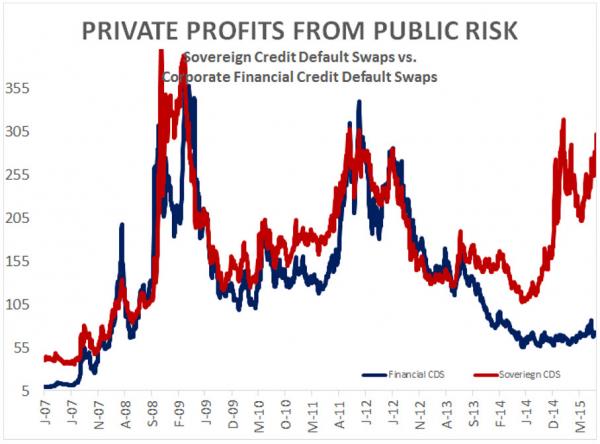
The arms race of devaluation is not free and has come at the cost of massive global debt expansion. There is no precedent in financial history for a robust economic recovery absent either debt reduction or rampant inflation. We never deleveraged, in fact we just doubled down. According to a recent McKinsey study the world has reached $200 trillion of debt in 2014 (286% of global GDP), which is a staggering 40% increase from 2007 levels (+$57 trillion). In China, debt has grown four times faster than GDP since 2007, and half of that debt is linked to their property market. The world has simply shifted private debt to the public balance sheet.

20151021_debt1_0

The private risk transfer to the public balance sheet can also be seen in the evolution of credit default swap pricing since 2007. Notice the sharp divergence between global sovereign CDS (red) and financial corporate CDS (blue) starting in 2013. The next major global crash will likely be driven by unhealthy sovereign credit rather than corporate credit. The next Lehman moment will be the financial collapse of a major developed country instead of a bank.

ddebt2_0

There are those who point to aggressive central banking of the late-1930s as the model for de-leveraging post-depression but this argument is highly flawed.

We didn’t financially engineer our way out of the Great Depression – we won a World War.

It’s extremely helpful in the de-leveraging process if you are the only capitalist industrial power left in the world untouched by utter and complete destruction. De-leveraging from the Great Depression had as much to do with the blood, sweat, and tears of American soldiers, the development of nuclear weapons, and the fact we were an ocean removed from the battlefield on both sides, as anything related to fiscal and monetary policy from the era.

I don’t think some investors are being radically honest when they omit this brutal truth in their analysis of late-1930s as model to argue for more quantitative easing. More quantitative easing is a great thing if you run a large risk parity fund but it will not help the American middle class.

Artemis Capital Management / Zero Hedge

Our laws and policies are more racist than the officers who enforce them

Police Killings of Blacks: Here Is What the Data Say

By SENDHIL MULLAINATHAN
NY Times : October 16, 2015

Tamir Rice. Eric Garner. Walter Scott. Michael Brown. Each killing raises a disturbing question: Would any of these people have been killed by police officers if they had been white?

I have no special insight into the psychology of police officers or into the complicated forensics involved in such cases. Answering this question in any single situation can be difficult and divisive. Two outside experts this month concluded, for example, that the shooting of Tamir Rice, a 12-year-old boy in Cleveland who was carrying a toy gun, was a “reasonable” if tragic response. That will hardly be the last word on the subject.As an economist who has studied racial discrimination, I’ve begun to look at these deaths from a different angle. There is ample statistical evidence of large and persistent racial bias in other areas — from labor markets to online retail markets. So I expected that police prejudice would be a major factor in accounting for the killings of African-Americans. But when I looked at the numbers, that’s not exactly what I found.

I’m not saying that the police in these specific cases are free of racial bias. I can’t answer that question. But what the data does suggest is that eliminating the biases of all police officers would do little to materially reduce the total number of African-American killings. Police bias may well be a significant problem, but in accounting for why some of these encounters turn into killings, it is swamped by other, bigger problems that plague our society, our economy and our criminal justice system.

To understand how this can be, let us start with the statistics on police killings. According to the F.B.I.’s Supplementary Homicide Report, 31.8 percent of people shot by the police were African-American, a proportion more than two and a half times the 13.2 percent of African-Americans in the general population. While this data may be imperfect, other sources in individual states or cities, such as in California or New York City, show very similar patterns.

The data is unequivocal. Police killings are a race problem: African-Americans are being killed disproportionately and by a wide margin. And police bias may be responsible. But this data does not prove that biased police officers are more likely to shoot blacks in any given encounter.

Instead, there is another possibility: It is simply that — for reasons that may well include police bias — African-Americans have a very large number of encounters with police officers. Every police encounter contains a risk: The officer might be poorly trained, might act with malice or simply make a mistake, and civilians might do something that is perceived as a threat. The omnipresence of guns exaggerates all these risks.

Such risks exist for people of any race — after all, many people killed by police officers were not black. But having more encounters with police officers, even with officers entirely free of racial bias, can create a greater risk of a fatal shooting.

Arrest data lets us measure this possibility. For the entire country, 28.9 percent of arrestees were African-American. This number is not very different from the 31.8 percent of police-shooting victims who were African-Americans. If police discrimination were a big factor in the actual killings, we would have expected a larger gap between the arrest rate and the police-killing rate.

This in turn suggests that removing police racial bias will have little effect on the killing rate. Suppose each arrest creates an equal risk of shooting for both African-Americans and whites. In that case, with the current arrest rate, 28.9 percent of all those killed by police officers would still be African-American. This is only slightly smaller than the 31.8 percent of killings we actually see, and it is much greater than the 13.2 percent level of African-Americans in the overall population.

If the major problem is then that African-Americans have so many more encounters with police, we must ask why. Of course, with this as well, police prejudice may be playing a role. After all, police officers decide whom to stop or arrest.

But this is too large a problem to pin on individual officers.

First, the police are at least in part guided by suspect descriptions. And the descriptions provided by victims already show a large racial gap: Nearly 30 percent of reported offenders were black. So if the police simply stopped suspects at a rate matching these descriptions, African-Americans would be encountering police at a rate close to both the arrest and the killing rates.

Second, the choice of where to police is mostly not up to individual officers. And police officers tend to be most active in poor neighborhoods, and African-Americans disproportionately live in poverty.

In fact, the deeper you look, the more it appears that the race problem revealed by the statistics reflects a larger problem: the structure of our society, our laws and policies.

The war on drugs illustrates this kind of racial bias. African-Americans are only slightly more likely to use drugs than whites. Yet, they are more than twice as likely to be arrested on drug-related charges. One reason is that drug sellers are being targeted more heavily than users. With fewer job options, low-income African-Americans have been disproportionately represented in the ranks of drug sellers. In addition, the drug laws penalize crack cocaine — a drug more likely to be used by African-Americans — far more harshly than powder cocaine.

Laws and policies need not explicitly discriminate to effectively discriminate. As Anatole France wrote centuries ago, “In its majestic equality, the law forbids rich and poor alike to sleep under bridges, beg in the streets and steal loaves of bread.”

(read the full article at NY Times)