All posts by alternativefreepress

Record Earthquake Activity in Oklahoma: Experts Blame Fracking

Series of small earthquakes rock Oklahoma in record seismic activity

By Carey Gillam
Reuters: April 5, 2014

Earthquakes rattled residents in Oklahoma on Saturday, the latest in a series that have put the state on track for record quake activity this year, which some seismologists say may be tied to oil and gas exploration.

One earthquake recorded at 3.8 magnitude by the U.S. Geological Survey rocked houses in several communities around central Oklahoma at 7:42 a.m. local time. Another about two hours earlier in the same part of the state, north of Oklahoma City, was recorded at 2.9 magnitude, USGS said.

Those two were preceded by two more, at 2.6 magnitude, and 2.5 magnitude, that also rolled the landscape in central Oklahoma early Saturday morning. A 3.0 magnitude tremor struck late Friday night in that area as well, following a 3.4 magnitude hit Friday afternoon.

Austin Holland, a seismologist with the Oklahoma Geological Survey who tracks earthquake activity for the USGS, said the earthquake activity in the state is soaring.

[…]

“We have already crushed last year’s record for number of earthquakes,” Holland said.

Most earthquakes occur naturally. But scientists have long linked some small earthquakes to oil and gas work underground, which can alter pressure points and cause shifts in the earth.

Oil and gas exploration has increased in recent years across the country, spurred by U.S. efforts for energy independence. Modern hydraulic fracturing, or fracking, is one particularly controversial technique.

For bigger quakes, so far this year the state has recorded 106 at 3.0 magnitude and above, according to Holland. For all of last year the state had 109 at 3.0 and above.

In November 2011, Oklahoma suffered a 5.6 magnitude quake that damaged more than a dozen homes and several businesses.

Wastewater disposal related to the fracking is suspected by many scientists to contribute to the earthquake activity. Millions of gallons of wastewater are typically trucked from a fracking site to wells where the water is injected thousands of feet underground into porous rock layers. That work, if done near a fault, can trigger larger quakes, according to several recent scientific studies.

Oklahoma recorded 278 earthquakes from 2008 through 2013 that have registered on the Richter scale at a magnitude of 3.0 or greater, a level that can shake objects inside a home.

Before that, from 1975-2008, the state on average recorded less than six earthquakes a year.

(Read the full article at Yahoo)

—-
Alterntaive Free Press – fair use –

Elections Canada Postpones Election Fraud Report Until After Next Election

AlternativeFreePress.com

An Elections Canada investigation into allegations of election fraud has been ongoing for more than a year. The intention was to finish that investigation by March 31 and then submit a “compliance and enforcement mechanisms” report to Parliament shortly after. However, Elections Canada spokeswoman Diane Benson has now said the agency has decided not to report until after the next election.

“In light of the government’s announcement in the fall that it would introduce comprehensive legislative reform, Elections Canada decided to postpone the general enforcement report until after the next general election,” she said. “This was necessary not only to focus our attention and resources on the announced reform, but also of the difficulty of engaging stakeholders simultaneously on a parallel initiative.”

Last year a federal court judge ruled that electoral fraud occurred during the last federal election. Federal Court Judge Richard Mosley ruled that the fraudulent phone calls “struck at the integrity of the electoral process by attempting to dissuade voters from casting ballots for their preferred candidates.” However Judge Mosley ridiculously did not overturn the election results. He wrote there was “a concerted campaign by persons who had access to a database of voter information maintained by a political party,” but apparently felt that this was acceptable because there was no evidence of direct involvement by a candidate and the outcome of the election could not be definitively proven to have been affected by the fraud.

With confirmation of election fraud, but a lack of action from the courts, Elections Canada’s report is vital information for the voting public to digest before the next election. The courts have failed to correct this assault on democracy, and now Elections Canada seem to be failing too.

Maude Barlow of the Council of Canadians comments: “This is appalling. In a disturbing parallel to the 1972 break-in at the Watergate office complex, Harper is trying to break into our democratic system with this legislation to cover-up the truth about what happened during the 2011 election from ever coming out. And so far it’s working … With this Election Fraud Cover-up Act, this Votergate, Harper has lost the right to govern. This is outrageous and there should be an immediate election over it. Any Conservative MP supporting this bill should take a long look in the mirror.”

Of course, the government’s proposed “Fair Elections Act” is worthy of focus. It is anti-democratic in multiple ways, but for Elections Canada to choose to focus on that instead of the election fraud is unacceptable. The two issues are one in the same, and Elections Canada should release their report before the next election regardless of what new laws are being proposed. The “Fair Elections Act” seeks to limit Elections Canada’s investigative powers and make it accountable to the government rather than Parliament as it is now, it is a direct response to the fraud investigation. The Conservatives have been caught cheating, and now they are changing the rules to ensure they can keep cheating. Canadians deserve to know what Elections Canada has found before they decide their next government.

Written by Alternative Free Press
Creative Commons License
Elections Canada Postpones Election Fraud Report Until After Next Election by AlternativeFreePress.com is licensed under a Creative Commons Attribution-ShareAlike 4.0 International License.

Sources for this article:

1. Former campaign worker granted immunity after he gives evidence in ‘Pierre Poutine’ robocalls case http://news.nationalpost.com/2014/04/03/former-campaign-worker-granted-immunity-after-he-gives-evidence-in-pierre-poutine-robocalls-case/

2. Andrew Coyne: What problems are the Conservatives really trying to solve with bizarre Fair Elections Act? http://fullcomment.nationalpost.com/2014/02/07/andrew-coyne-what-problems-are-the-conservatives-really-trying-to-solve-with-bizarre-fair-elections-act/

3. Elections Canada may never release fraud report because of “Unfair” Elections Act http://www.canadians.org/media/elections-canada-may-never-release-fraud-report-because-unfair-elections-act

—-
Alternative Free Press – fair use –

23 Flawed Nuclear Reactors in the USA: Fukushima, General Electric & the Obama Administration

AlternativeFreePress.com

General Electric’s Mark 1 system has had known unacceptable safety risks for decades, and the nuclear industry has incredibly limited liability.

In 1972, Stephen H. Hanauer, then a safety official with the Atomic Energy Commission, recommended that the Mark 1 system be discontinued because it presented unacceptable safety risks. Among the concerns cited was the smaller containment design, which was more susceptible to explosion and rupture from a buildup in hydrogen — a situation that may have unfolded at the Fukushima Daiichi plant. Later that same year, Joseph Hendrie, who would later become chairman of the Nuclear Regulatory Commission, a successor agency to the atomic commission,said the idea of a ban on such systems was attractive. But the technology had been so widely accepted by the industry and regulatory officials, he said, that “reversal of this hallowed policy, particularly at this time, could well be the end of nuclear power.”

NY Times

On February 2, 1976, Gregory C. Minor, Richard B. Hubbard, and Dale G. Bridenbaugh “blew the whistle” on safety problems at nuclear power plants. The three engineers gained the attention of journalists, and their disclosures about the threats of nuclear power had a significant impact. They timed their statements to coincide with their resignations from responsible positions in General Electric’s nuclear energy division, and later established themselves as consultants on the nuclear power industry for state governments, federal agencies, and overseas governments… Bridenbaugh described design flaws of General Electric’s Mark 1 reactors, which account for five of the six reactors at the Fukushima 1 power plant. Bridenbaugh claimed that the design “did not take into account the dynamic loads that could be experienced with a loss of coolant” and that, despite efforts to retrofit the reactors, “the Mark 1 is still a little more susceptible to an accident that would result in a loss of containment.”

Wikipedia

A year after the disaster, Tepco was taken over by the Japanese government because it couldn’t afford the costs to get the damaged reactors under control. By June of 2012, Tepco had received nearly 50 billion dollars from the government.

The six reactors were designed by the U.S. company General Electric (GE). GE supplied the actual reactors for units one, two and six, while two Japanese companies Toshiba provided units three and five, and Hitachi unit four. These companies as well as other suppliers are exempted from liability or costs under Japanese law.

Many of them, including GE, Toshiba and Hitachi, are actually making money on the disaster by being involved in the decontamination and decommissioning, according to a report by Greenpeace International.

“The nuclear industry and governments have designed a nuclear liability system that protects the industry, and forces people to pick up the bill for its mistakes and disasters,” says the report, “Fukushima Fallout“.

“If nuclear power is as safe as the industry always claims, then why do they insist on liability limits and exemptions?” asked Shawn-Patrick Stensil, a nuclear analyst with Greenpeace Canada.

Nuclear plant owner/operators in many countries have liability caps on how much they would be forced to pay in case of an accident. In Canada, this liability cap is only 75 million dollars. In the United Kingdom, it is 220 million dollars. In the U.S., each reactor owner puts around 100 million dollars into a no-fault insurance pool. This pool is worth about 10 billion dollars.

“Suppliers are indemnified even if they are negligent,” Stensil told IPS.

IPS

NBC News has reported that there are 23 nuclear plants in the United States that use the GE Mark 1 BWR. Yes, 23. There are 23 nuclear plants in the United States where the used fuel rods are suspended, in a pond, 100 feet above the ground. Additionally, 12 more reactors in the USA have GE’s later Mark II or Mark III containment system.

” Jeffery Immelt is the head of GE. He is also the head of the United States Economic Advisory Board. He was invited to join the board personally by President Obama in 2009 and took over as head in 2011 when Paul Volcker stepped down in February 2011, just a month before the earthquake and tsunami that devastated Fukushima.

Paul Volcker was often seen as being at odds with the administration, and many of his ideas were not embraced by the government. The appointment of Immelt, a self-described Republican, was seen as a move to give Obama a leg up when dealing with the Republican majority in the House.

There have been calls from many organizations for GE to be held accountable for the design faults in the reactors that powered the Fukushima plant. The fact that they had been known for so long does seem to indicate that the company ignored and over-ruled advice from nuclear experts.

… Any admission that radiation has spread across the Pacific Ocean and contaminated American soil is an admission that the technology was flawed, and that same flawed technology is being used in the United States. The government does not want anyone looking closer at the situation. They don’t want people poking around asking questions about why the radiation got out in the first place…it’s too close to home.

Better to say that the radiation is within safe levels, and then if such a disaster happens here they can mourn those in the immediate fallout zone and maintain that the rest of the country is okay, just as it was after Fukushima.

The fact that the CEO of GE works for Obama just highlights the facts. There is no way that Immelt doesn’t know about all the warning his company was given about the design flaws of the Mark 1; and if he knows, the government knows.”

The Daily Sheeple

Can we trust the Obama Administration?
Can we trust the 23 Mark 1 reactors in the United States?

Compiled by Alternative Free Press
Creative Commons License
23 Flawed Nuclear Reactors in the USA: Fukushima, General Electric & the Obama Administration by AlternativeFreePress.com is licensed under a Creative Commons Attribution-ShareAlike 4.0 International License.

—-
Alternative Free Press – fair use –

The NSA Documents Database: All Snowden leaks sorted & searchable

The American Civil Liberties Union (ACLU) has launched a user-friendly online database which contains all of the documents leaked by Edward Snowden which have been made public so far. Of course there is still more to come as well, Mr Snowden has said “Some of the most important reporting is yet to come.”. As the rest of the documents are released, the ACLU will add them to the database.

Emily Weinrebe of the ACLU’s National Security writes: “These documents stand as primary source evidence of our government’s interpretation of its authority to engage in sweeping surveillance activities at home and abroad, and how it carries out that surveillance. The ACLU hopes to facilitate this debate by making these documents more easily accessible and understandable.”

With full search and filtering functions finding the documents most relevant to any specific topic should be easy.

Weinrebe concludes, “The fact is that most of the documents contained in this database should have never been secret in the first place. Now, with newfound access to these records, we can educate ourselves about the true nature and scope of government surveillance in its many forms. This database will serve as a critical tool with which we will hold our government accountable.”

The NSA Documents Database: https://www.aclu.org/nsa-documents-search

Written by Alternative Free Press
Creative Commons License
The NSA Documents Database: All Snowden leaks sorted & searchable by AlternativeFreePress.com is licensed under a Creative Commons Attribution-ShareAlike 4.0 International License.

Organic Standards Are Being Watered Down

Corporate Clout Chips Away at Organic Standards

By Alexis Baden-Mayer and Ronnie Cummins
Organic Consumers Association: April 2, 2014

The Organic Consumers Association has a long history of defending the integrity of organic standards.

Last September, the U.S. Department of Agriculture (USDA), under pressure from corporate interests represented by the Organic Trade Association, made our job harder.

They also made it more important than ever for consumers to do their homework, even when buying USDA certified organic products.

Without any input from the public, the USDA changed the way the National Organic Standards Board (NOSB) decides which non-organic materials are allowed in certified organic. The change all but guarantees that when the NOSB meets every six months, the list of non-organic and synthetic materials allowed in organic will get longer and longer.

The USDA’s new rule plays to the cabal of the self-appointed organic elite who want to degrade organic standards and undermine organic integrity. For consumers, farmers, co-ops and businesses committed to high organic standards, the USDA’s latest industry-friendly move is a clarion call to fight back against the corporate-led, government-sanctioned attack on organic standards.

Old rules, new rules

The NOSB, a federal advisory committee appointed by the Secretary of Agriculture, decides what is allowed on the National List of non-organic materials approved for use in organic. Prior to last September’s new ruling, each non-organic material on the list had to be reviewed every five years, using what’s called the “sunset process.” Under this process, five years after a non-organic material was added to the National List, it would be automatically removed, unless a two-thirds majority of the NOSB board voted to keep the material on the list.

The intent behind this process was clear. Maximize flexibility for the organic industry, minimize the use of non-organic materials in organic, and encourage continuous improvement of the organic standard.

But last September, the USDA reversed this process. Now, instead of automatically coming up for review after five years, each non-organic material will automatically—and indefinitely—stay on the National List unless a two-thirds majority of the NOSB board votes to remove it. And that’s not likely to happen, given that the 15-member board of the NOSB is stacked with industry reps who consistently vote with industry against consumers.

Labels help, but . . .

Should you just give up on the organic label? Absolutely not. With all its flaws, USDA Organic is still the only credible and comprehensive certification program in the natural foods marketplace. The new rules mean you’ll have to scrutinize labels more carefully than ever. But even then, you won’t get the whole picture when it comes to non-organic substances in organics.

Certain non-organic or synthetic materials can be used in up to 5 percent of a “USDA Organic” product, and in up to 30 percent of a “Made with Organic” product.

Under the new rules, the list of non-organic or synthetic ingredients allowed at those percentages will likely grow. But here’s something most consumers don’t realize: The National List isn’t just about synthetic and non-organic ingredients that are allowed in food. The list also governs every non-organic material or synthetic material used in the production of organic food, from farm to fork. (Here’s the complete list). As that list, too, grows, organic standards will continue to erode. And as a consumer, you’ll have a difficult time identifying those materials as they won’t be listed on the product’s label.

What non-organic materials should you look for on food labels? Here are a few of the worst ones:

Carrageenan, an additive linked to gastrointestinal inflammation and higher rates of colon cancer. More here: http://salsa3.salsalabs.com/o/50865/p/dia/action3/common/…

Synthetic nutrients, including DHA and ARA which have been linked to severe gastrointestinal distress, prolonged periods of vomiting and painful bloating.

Sausage casings made from processed intestines

What won’t you find on food labels, but should be aware that the NOSB has approved for organic? And because of the new rule, likely won’t revisit?

Synthetic methionine: In 2001, the NOSB approved the synthetic version of methionine, a sulfur-based essential amino acid, for use in livestock feed—but only, as the Rodale Institute points out, after organic poultry farmers realized the substance was already in the feed they were using. As long as synthetic methionine remains on the list of approved substances in organics, organic farmers can continue to keep chickens confined. Why? Because, again according to the Rodale Institute, synthetic methionine keeps confined chickens healthy. Take the synthetic out of the feed, and you have to allow the chickens access to outdoor pastures in order to maintain their health. But wouldn’t that be a good thing?

Genetically engineered vaccines: Genetically modified organisms, and the genetic engineering process itself, are not allowed in certified organic products. But there’s one exception. Genetically engineered vaccines can be used in organic livestock production, on the condition that the vaccines are included on the National List. So which genetically engineered vaccines did the NOSB approve for the National List? All of them. Instead of reviewing the safety of each vaccine individually, as the law clearly intends, the NOSB included all genetically engineered vaccines on the list, as a single group of “synthetic substances.” Now that the sunset process has been weakened, what are the chances of getting genetically engineered vaccines off of the list of approved substances? Next to none.

Antibiotics: Under organic standards, antibiotics can’t be used in animals. But there’s a little-known loophole, applicable only to poultry, that says the standard doesn’t take effect until “the second day of life.” So as it turns out, the eggs that hatch into organic chickens are routinely injected with an antibiotic called gentamicin, which is also used to treat bacterial skin infections in humans. Because of the loophole, the use of gentamicin in organic poultry production has never been subject to the NOSB’s sunset process. The process does, however, govern the use of antibiotics sprayed on apple and pear trees to control something called fire blight. Under the old rules, the NOSB voted to end the use of those antibiotics—tetracycline and streptomycin—as of October 21, 2014. But industry is fighting that ruling. If it succeeds, and the NOSB ever re-lists those antibiotics, the changes to the sunset process will make it more difficult than ever to get tetracycline and streptomycin off of the National List of approved substances.

Mutagenesis: There’s another loophole in the “no genetic engineering in organics” standard. It’s called mutagenesis. In 2011, the NOSB approved synthetic DHA and ARA for use in organics. As mentioned above, these synthetic nutrients, used in baby formula, are linked to side effects. But what you won’t learn from reading the labels on baby formula, or any other product containing DHA or ARA, is that these synthetic nutrients are derived from mutated microorganisms, created through a process called mutagenesis. We believe mutagenesis is a form of genetic engineering, and others support http://www.gmo-compass.org/eng/search/ our position. But when Martek Biosciences Corp., the manufacturer of synthetic DHA, argued that mutagenesis should be allowed because the process is nothing more than a form of classical seed breeding, the NOSB sided with the company. So while consumers can see DHA and ARA on product labels, few will know that they are produced using a technique that has dangers similar to genetic engineering.

Defending organic standards

The NOSB meets again April 29-May 2, 2014. For the first time, it will be operating under the new rule. The USDA didn’t give the public an opportunity to comment on its change to the sunset process, but that doesn’t mean the agency is immune to public outcry. Starting with President Obama and USDA Secretary Vilsack, we need to press USDA leadership to reverse this disastrous new rule.

Please sign and share our petition: here

(originally published at The Organic Consumers Association

—-
Alternative Free Press – fair use –

Canadian couple detained in hospital against will

Douglas and Pamela Allen are asking a court to order their release from Victoria General Hospital

Elderly couple demand hospital end ‘illegal detention’

CBC: April 3, 2014

An elderly Victoria couple has gone to B.C. Supreme Court to try to take back control of their lives, after they were committed and held in hospital after going there for care.

In court documents, the Vancouver Island Health Authority claims Pamela and Douglas Allen were suffering from neglect and poor nutrition because of a range of complex health conditions when they attended Victoria’s Royal Jubilee Hospital looking for care in January.

According to court documents, several doctors diagnosed both with dementia, and each was committed under the Mental Health Act. They are now residing at Victoria General Hospital.

The doctors found both incapable of caring for themselves or each other at their suite in an independent living home for seniors, which they recently bought.

They also had their bank accounts frozen and placed under the control of the Public Guardian.

But the 84-year-olds claim they are capable of looking after themselves with the aid of a nurse, and recorded a video statement from the hospital ward that is now their home and what they describe as their prison.

In the video, Pamela is in a wheelchair and Douglas is confined to a bed by a restraining vest.

“I want to go to my home,” says Pamela in the video. “They won’t let us go to our own home and we haven’t done anything.”
Lawyer seeks release

Their lawyer, Jonathan Aiyadurai, said they should be released from the hospital ward where they’re being kept.

“They’re bored – my clients have not had a breath of fresh air since they went into the general hospital. No windows have been opened for them,” he said.

“They haven’t been allowed outside. The husband has been put in a straitjacket — very draconian and Kafkaesque if I may say, and this is all at the taxpayers’ expense.”

Aiyadurai said the Allens are willing to pay for a nurse to visit them daily at their independent living unit, which they bought before being committed.

“Perhaps if my clients need some care – why can’t they get that out in the community?”

He said his clients want the public to hear their story, and that’s why they recorded the video.

“Wouldn’t people like to know that that can happen?”

The couple’s legal action also claims they were poorly fed and bathed at the James Bay Care Centre, that Pamela is being treated with insulin against her will, that they have not been allowed to attend their church, and that they have no access to their personal belongings, including Douglas’s confiscated wallet.

(Read the full article at CBC)

—-
Alterntaive Free Press – fair use –

Conspiracy Fact – How the U.S. Government Covertly Invented a “Cuban Twitter” to Create Revolution

By Michael Krieger
Liberty Blitzkrieg: April 3, 2014

It appears the U.S. government is doing its best to ensure that nobody anywhere in any corner of planet earth will ever trust American technology again (or U.S. aid for that matter). This process of distrust first really got going with the Edward Snowden revelations, which demonstrated that essentially all major U.S. tech firms are mere wards of the state with little to no privacy protections, and absolutely zero backbone.

This story of the U.S. government covertly creating a “Cuban Twitter” called ZunZuneo in order to overthrow the regime there has enormous long-term ramifications on many, many levels, which I will address throughout this post.

From the AP via The Washington Post:

WASHINGTON — In July 2010, Joe McSpedon, a U.S. government official, flew to Barcelona to put the final touches on a secret plan to build a social media project aimed at undermining Cuba’s communist government.


McSpedon and his team of high-tech contractors had come in from Costa Rica and Nicaragua, Washington and Denver. Their mission: to launch a messaging network that could reach hundreds of thousands of Cubans. To hide the network from the Cuban government, they would set up a byzantine system of front companies using a Cayman Islands bank account, and recruit unsuspecting executives who would not be told of the company’s ties to the U.S. government.


McSpedon didn’t work for the CIA. This was a program paid for and run by the U.S. Agency for International Development, best known for overseeing billions of dollars in U.S. humanitarian aid.

Now we can pretty much guarantee that foreign nations will forever be skeptical of any U.S. “aid”. Great work morons.

Documents show the U.S. government planned to build a subscriber base through “non-controversial content”: news messages on soccer, music, and hurricane updates. Later when the network reached a critical mass of subscribers, perhaps hundreds of thousands, operators would introduce political content aimed at inspiring Cubans to organize “smart mobs” — mass gatherings called at a moment’s notice that might trigger a Cuban Spring, or, as one USAID document put it, “renegotiate the balance of power between the state and society.”


At its peak, the project drew in more than 40,000 Cubans to share news and exchange opinions. But its subscribers were never aware it was created by the U.S. government, or that American contractors were gathering their private data in the hope that it might be used for political purposes.


“There will be absolutely no mention of United States government involvement,” according to a 2010 memo from Mobile Accord, one of the project’s contractors. “This is absolutely crucial for the long-term success of the service and to ensure the success of the Mission.”


The program’s legality is unclear: U.S. law requires that any covert action by a federal agency must have a presidential authorization. Officials at USAID would not say who had approved the program or whether the White House was aware of it. McSpedon, the most senior official named in the documents obtained by the AP, is a mid-level manager who declined to comment.

“The program’s legality is unclear”, as if that matters!

But the ZunZuneo program muddies those claims, a sensitive issue for its mission to promote democracy and deliver aid to the world’s poor and vulnerable — which requires the trust of foreign governments.


The Associated Press obtained more than 1,000 pages of documents about the project’s development. The AP independently verified the project’s scope and details in the documents — such as federal contract numbers and names of job candidates — through publicly available databases, government sources and interviews with those directly involved in ZunZuneo.


“We should gradually increase the risk,” USAID proposed in a document. It advocated using “smart mobs” only in “critical/opportunistic situations and not at the detriment of our core platform-based network.”


USAID’s team of contractors and subcontractors built a companion Web site to its text service so Cubans could subscribe, give feedback and send their own text messages for free. They talked about how to make the Web site look like a real business. “Mock ad banners will give it the appearance of a commercial enterprise,” a proposal suggested.


McSpedon worked for USAID’s Office of Transition Initiatives (OTI), a division that was created after the fall of the Soviet Union to promote U.S. interests in quickly changing political environments — without the usual red tape.

We have an “Office of Transition Initiatives“? Who knew…

In 2009, a report by congressional researchers warned that OTI’s work “often lends itself to political entanglements that may have diplomatic implications.” Staffers on oversight committees complained that USAID was running secret programs and would not provide details.


“We were told we couldn’t even be told in broad terms what was happening because ‘people will die,’” said Fulton Armstrong, who worked for the Senate Foreign Relations committee. Before that, he was the US intelligence community’s most senior analyst on Latin America, advising the Clinton White House.

How’s that for Congressional oversight. This phony “people will die” rationale seems to be the reason for all shady secret programs these days.

The money that Creative Associates spent on ZunZuneo was publicly earmarked for an unspecified project in Pakistan, government data show. But there is no indication of where the funds were actually spent.


Paula Cambronero, a researcher for Mobile Accord, began building a vast database about the Cuban subscribers, including gender, age, “receptiveness” and “political tendencies.” USAID believed the demographics on dissent could help it target its other Cuba programs and “maximize our possibilities to extend our reach.”

Of course, the NSA would never compile such data domestically, right?

Carlos Sanchez Almeida, a lawyer specializing in European data protection law, said it appeared that the U.S. program violated Spanish privacy laws because the ZunZuneo team had illegally gathered personal data from the phone list and sent unsolicited emails using a Spanish platform. “The illegal release of information is a crime, and using information to create a list of people by political affiliation is totally prohibited by Spanish law,” Almeida said. It would violate a U.S-European data protection agreement, he said.


“If it is discovered that the platform is, or ever was, backed by the United States government, not only do we risk the channel being shut down by Cubacel, but we risk the credibility of the platform as a source of reliable information, education, and empowerment in the eyes of the Cuban people,” Mobile Accord noted in a memo.


To cover their tracks, they decided to have a company based in the United Kingdom set up a corporation in Spain to run ZunZuneo. A separate company called MovilChat was created in the Cayman Islands, a well-known offshore tax haven, with an account at the island’s Bank of N.T. Butterfield & Son Ltd. to pay the bills.


A memo of the meeting in Barcelona says that the front companies would distance ZunZuneo from any U.S. ownership so that the “money trail will not trace back to America.”


Officials at USAID realized however, that they could not conceal their involvement forever — unless they left the stage. The predicament was summarized bluntly when Eberhard was in Washington for a strategy session in early February 2011, where his company noted the “inherent contradiction” of giving Cubans a platform for communications uninfluenced by their government that was in fact financed by the U.S. government and influenced by its agenda.


They turned to Jack Dorsey, a co-founder of Twitter, to seek funding for the project. Documents show Dorsey met with Suzanne Hall, a State Department officer who worked on social media projects, and others. Dorsey declined to comment.

This is not going to be good for Twitter’s reputation internationally, or Facebook for that matter…

By early 2011, Creative Associates grew exasperated with Mobile Accord’s failure to make ZunZuneo self-sustaining and independent of the U.S. government. The operation had run into an unsolvable problem. USAID was paying tens of thousands of dollars in text messaging fees to Cuba’s communist telecommunications monopoly routed through a secret bank account and front companies. It was not a situation that it could either afford or justify — and if exposed it would be embarrassing, or worse.

If you did this it’d probably be called money laundering and you’d be locked up in a cage forever. Such as what happened to Charlie Shrem.

Toward the middle of 2012, Cuban users began to complain that the service worked only sporadically. Then not at all.


ZunZuneo vanished as mysteriously as it appeared.

(Read the full article at Liberty Blitzkrieg)

—-
Alternative Free Press

It’s Not Just the Stock Market That’s Rigged: the Entire Status Quo Is Rigged

By Charles Hugh Smith
Of Two Minds: April 2, 2014

One has to wonder why we are dodging this truth about what we’ve become: a nation that turns a blind eye to skimmers, scammers and legal looting.


As in the story of the Emperor’s new clothes, the onlooker who declares the obvious– in this case, that the stock market is rigged–shatters the consensus lie.In the current saga, author Michael Lewis plays the role of the truth-telling boy, and everyone who went along with the fiction that the Emperor’s high-frequency trading finery was resplendent is revealed as credulous, complicit or worse.


Lewis’ new book is Flash Boys: A Wall Street Revolt.


The high-frequency trading (HFT) scam is old news, and a number of fine books have addressed the mechanics of the skim, for example Dark Pools: High-Speed Traders, A.I. Bandits, and the Threat to the Global Financial System by Scott Patterson.


Many in the alternative financial media have written about HFT for years. Here are two of my own entries on the topic:


The Stock Market Is an “Attractive Nuisance” and Should Be Closed (August 22, 2012)


We Need a New Stock Market (September 14, 2012)


Interestingly, Mr. Patterson outlined the solution that the heroes of Lewis’ book ended up pursuing. Here is a Q&A I conducted with Patterson in September 2012:

CHS: While there are various regulatory “tweaks” that could be put in place, I wonder if we don’t need a more fundamental “re-set” that asks what role the market should play in finance and the economy inhabited by everyday investors. 

Scott: I think there are a lot of people in the industry wondering about whether there needs to be a massive overhaul. But it’s probably not a good idea for that to be imposed on the market by the SEC. The uncertainty would be potentially destabilizing. And I just don’t see it happening.
I think the change needs to come from within the market and needs to be imposed by its most important users–I mean, not the high-frequency traders, who are running the show at the exchanges in many ways–but the institutions, the giant mutual fund companies, the pension funds, the long-short hedge funds. They need to exert pressure on the exchanges to stop giving advantages to high-frequency firms.

If we pull back from the media frenzy about HFT, we find the market is rigged in many other ways. The Federal Reserve’s policies, stripped of Orwellian mumbo-jumbo, are all about rigging the market to go in one direction–up.


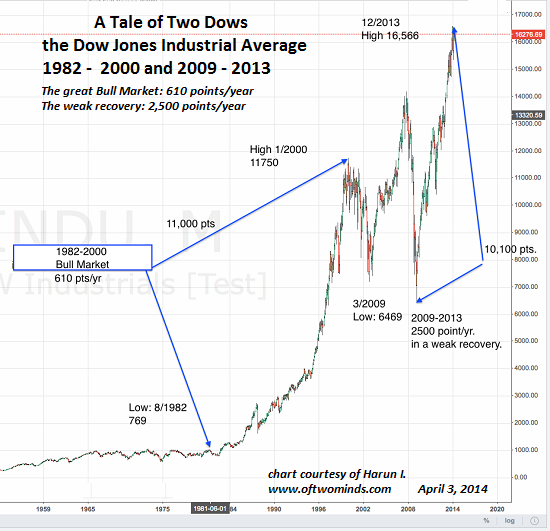
Consider this chart, courtesy of long-time contributor Harun I., of the Dow Jones Industrial Average: I call it the tale of Two Dows. In the Great Bull Market of 1982 – 2000, a market fueled by an extraordinary economic expansion, the DJIA gained an average of 610 points a year.


In the anemic “recovery” of 2009 – 2013, the DJIA gained an average of 2,500 points per year. While the Fed rigged the 1990s Bull Market with low interest rates and other policies, it pulled out all the stops in the last five years:


The stock market is only the tip of the iceberg of what’s being rigged. For a taste of what’s rigged, ask yourself this question: if Mr. Elite Insider perpetrates a scam, and Mr. John Q. Citizen breaks similar laws, is there any difference between the treatment each receives?


Let’s go even deeper and ask: why is looting legal, even though it is obviously crooked? Why is high-frequency trading legal? Why is it legal for the Fed to offer money at 0% to its buddies but not to Mr. John Q. Citizen?


Why is it legal to issue student loans to future debt-serfs that is unlike all other debt in that it cannot be discharged in bankruptcy?


Since the legal looting continues unabated regardless of what party or toady is in office, then what actual difference is there between the Demopublicans and Republicrats?


It’s not just the stock market that’s rigged–the entire Status Quo is rigged. There are two sets of laws and two sets of opportunities: one for those holding the concentrated wealth and power, and the other for the rest of us debt-serfs.


If the system isn’t rigged, then why are insolvent banks and bankers protected from the creative destruction of capitalism that befalls John Q. Citizen when his risky bets go bad? Why do we as a nation keep insisting the Emperor’s new clothes are splendid when he is in fact parading around buck-naked?


One has to wonder why we are dodging this truth about what we’ve become: a nation that turns a blind eye to skimmers, scammers and legal looting. Perhaps, in Joseph Conrad’s phrase, we hope to escape the grim shadow of self-knowledge.

(Read the full article at Of Two Minds)

—-
Alternative Free Press