Australians were killed by a US drone strike, and we deserve to know why

Antony Loewenstein
The Guardian : April 29, 2014

The news that the US had killed two Australian “militants” in a drone strike was announced in mid-April. Christopher Havard and “Muslim bin John”, who also held New Zealand citizenship, were allegedly killed by a CIA-led airstrike in eastern Yemen in November last year.

Readers were given little concrete information, apart from a “counter-terrorism source” who claimed that both men were foot soldiers for Al-Qaida in the Arabian Peninsula, though they may also have been collateral damage (the real target being other terror heads).

The Australian government claimed ignorance of the entire operation. “There was no Australian involvement in, or prior awareness of, the operation”, a spokesman said. New Zealand prime minister John Key released some more details, saying that the country’s GCSB spies had been authorised to spy on him. “I knew that he had gone there [to Yemen] and gone to a terrorist training camp”, he stated.

Since publication of these bare facts, little new information has emerged from the government or other sources – except for some reporting in The Australian about Havard’s apparent transformation after he converted to Islam in his early 20s and went to Yemen to teach English. The paper editorialised in support of the strike: “to be killed in this way is regrettable”, it wrote, but obliterating civilians without a trial was acceptable because “such attacks have done much to stop the terrorists committing even more atrocities.” There was no condemnation of the scores of civilians killed by drones since 9/11.

It’s of course morally convenient to believe that the death of these men will make the world a safer place by removing “threats” without the need to place western soldiers in harm’s way – this is, after all, the apparently compelling logic of drone warfare. But it’s a myth challenged by the former drone pilots featured in the recently released documentary Drone, in which ex-Air Force pilot Michael Haas explains that:

You never know who you’re killing, because you never actually see a face. You just have a silhouette. They don’t have to take a shot. They don’t have to bear that burden. I’m the one that has to bear that burden.

Yet, uncertainty be damned, the Australian government seems to keep on supporting the CIA killings with most of the media following without question.

(Read the full article at The Guardian)

—-
Alternative Free Press -fair use-

Monsanto GMO Soy Is Scarier Than You Think

By Tom Philpott
Mother Jones: April 23, 2014

Soybeans are the second-largest US crop after corn, covering about a quarter of American farmland. We grow more soybeans than any other country except Brazil. According to the US Department of Agriculture, more than 90 percent of the soybeans churned out on US farms each year are genetically engineered to withstand herbicides, nearly all of them involving one called Roundup.
[…]

After harvest, the great bulk of soybeans are crushed and divided into two parts: meal, which mainly goes into feed for animals that become our meat, and fat, most of which ends up being used as cooking oil or in food products. According to the US Soy Board, soy accounts for 61 percent of American’s vegetable oil consumption.

Given soy’s centrality to our food and agriculture systems, the findings of a new study published in the peer-reviewed journal Food Chemistry are worth pondering. The authors found that Monsanto’s ubiquitous Roundup Ready soybeans, engineered to withstand its own blockbuster herbicide, contain more herbicide residues than their non-GMO counterparts. The team also found that the GM beans are nutritionally inferior.

In the study, the researchers looked at samples of three kinds of soybeans grown in Iowa: (1) those grown from GM herbicide-tolerant seeds; (2) those grown from non-GM seeds but in a conventional, agrichemical-based farming regime; and (3) organic soybeans, i.e., non-GM and grown without agrichemicals.

They found residues of glyphosate (the active ingredient in Roundup) and aminomethylphosphonic acid, or AMPA, the compound glyphosate breaks down into as it decays, on all 10 of the GM samples—and in none of the non-GM and organic ones.

The GMO soy had total residues averaging 11.9 parts per million, with a maximum reading of 20.1 ppm; the average is well below the Environmental Protection Agency’s limit of 20 ppm, a limit shared by the European Union. Yet as the authors note, back in 1999, Monsanto itself reported that the maximum recorded reading of glyphosate residue found on Roundup Ready soy was 5.6 ppm—a level it called “extreme” and “far higher than those typically found.”

So, the researchers found residue levels well below the EPA’s limit, but hovering above a level Monsanto itself has characterized as “extreme.” What to make of it?

As the authors note, the science around the effects of glyphosate at relatively low levels is controversial. By setting the residue limit at 20 parts per million, US and European regulators are endorsing a no-harm view. But some independent research, including a 2012 study (my account here) by University of Pittsburgh scientist Rick Relyea, found that Roundup in water at 3 ppm induced morphological changes in frogs. And in a 2012 paper, German researchers subjected various bacterial strains typically found in the guts of poultry to glyphosate at levels of 5 ppm and lower and found that it tended to harm beneficial bacteria like Lactobacillus, while pathogens like Salmonella entritidi tended to be “highly resistant” to it. The results suggest that glyphosate can shift the balance of the gut microbiota—hardly comforting, given the surge in research finding that subtle changes to the bacteria in our bodies have a huge impact on our health.

The study also found small but statistically significant differences in the nutritional quality of the soybean types: The organic soybeans had slightly higher protein levels than the other two, and lower levels of omega-6 fatty acids. Omega-3 fatty acids showed no significant difference. Both fats are essential in human diets, but research suggests that US eaters tend to consume a higher ratio of omega-6 acids to omega-3 acids than is healthy.

It’s worth noting that food isn’t glyphosate’s only pathway to our bodies. In a 2011 study, researchers for the US Geological Survey “frequently detected” glyphosate in surface waters, rain, and air in the Mississippi River basin. “The consistent occurrence of glyphosate in streams and air indicates its transport from its point of use into the broader environment,” USGS stated in a press release, adding that “we know very little about its long term effects to the environment.”

Charles Benbrook, a Washington State University researcher who documented the rise in glyphosate use that has accompanied Roundup Ready crops, told me that “human dietary exposure to glyphosate is now probably the highest ever for any pesticide used in the US.” When you consider the additional doses we get through water and air, the chemical stands “in a class by itself” in terms of human exposure. “I sure hope EPA is right in its evaluation of the toxicity of glyphosate,” he said.

Thus a plague of herbicide-resistant weeds and a corresponding spike in herbicide use may not be the only black marks against Monsanto’s blockbuster Roundup Ready crops.

(read the full article at Mother Jones)

—-
Alternative Free Press -fair use-

Odessa slaughter: How vicious mob burnt Ukraine anti-govt activists alive

RT: May 3, 2014

Dozens of people died in flames in Odessa, when radicals set ablaze the local House of Trade Unions with anti-government protesters blocked inside. The city is now in mourning for those who died, suffocated in smoke or had to jump out of windows.

What triggered the tragedy were violent clashes, which erupted on Friday afternoon between two rival rallies in Ukraine’s port-city of Odessa.

Around 1,500 supporters of the Kiev authorities, accompanied by aggressive fans of the local football club, Chernomorets, tried to march through the center of the city chanting “Glory to Ukraine,” “Death to enemies,” “Knife the Moskals [derogatory for Russians].” Some of the people in the group were wearing ultra-nationalist Right Sector movement insignia, were armed with chains and bats and carried shields.

Several hundred anti-government activists eventually confronted the procession. Fighting broke out as a result, with members of the rival groups throwing stones, Molotov cocktails and smoke grenades at each other and at police. The pavements were spattered with blood.

The police failed to draw the rival groups apart. As a result, 4 people were killed and 37 wounded in the violence. Police were among the injured.

Street clashes appeared to be only the beginning of the Odessa Friday nightmare, as radicals started to drive anti-government activists back to their tent camp in front of the local House of Trade Unions. Many anti-Kiev protesters eventually hid inside the building.

“Women and children were hiding in the Trade Union’s building,” an eye-witness told RT. “First the armed men set fire to tents, then they started throwing Molotov cocktails and grenades at the building. We heard shots fired and saw smoke,” she added.

The first floor of the Trade Unions building was soon engulfed in flames. The people inside appeared to be trapped.

Dozens eventually burnt alive or suffocated to death. To escape the fire and smoke, people were hanging out of windows and sitting on windowsills. In sheer desperation, some of them eventually jumped to the ground.

Many of those who managed to escape the fire were then brutally beaten by armed men, believed to be from the ultra-nationalist Right Sector group, who had the building under siege.

(read the full article including pictures and video at RT)

—-
Alternative Free Press -fair use-

Wall Street and the Global Laundering of Drug Money

Big Banks Started Laundering Massive Sums of Drug Money In the 1980s … And Are Still Doing It Today

Washington’s Blog: May 2, 2014

For More Than 30 Years, the Big Banks Have Been Key Players In the Drug Trade

Official statistics show that huge sums of drug money are laundered every year:

The United Nations Office on Drugs and Crime (UNODC) conducted a study to determine the magnitude of illicit funds generated by drug trafficking and organised crimes and to investigate to what extent these funds are laundered.  The report estimates that in 2009, criminal proceeds amounted to 3.6% of global GDP, with 2.7%  (or USD 1.6 trillion) being laundered.

This falls within the widely quoted estimate by the International Monetary Fund, who stated in 1998 that the aggregate size of money laundering in the world could be somewhere between two and five percent of the world’s gross domestic product.  Using 1998 statistics, these percentages would indicate that money laundering ranged between USD 590 billion and USD 1.5 trillion. At the time, the lower figure was roughly equivalent to the value of the total output of an economy the size of Spain.

Indeed, the head of the United Nations Office on Drugs and Crime says that drug dealers kept the banking system afloat during the depths of the 2008 financial crisis.

This started a long time ago. For example, Citibank was caught laundering drug money for Mexican cartels in 2001.

In the 1990s, earlier, Citibank apparently set up special client accounts for a big drug dealer:

One of the more infamous cases involving taxpayer bailed-out Citigroup’s ties to money laundering drug cartels emerged in the late 1990s when Raúl Salinas de Gortari, the brother of former Mexican President Carlos Salinas, was arrested after his wife, Paulina Castañón, attempted to withdraw $84 million from a Swiss account controlled by Raúl under an alias.

***

According to a 1995 Los Angeles Times report, Salinas “amassed at least $100 million in suspected drug money.”

Switzerland’s top prosecutor at the time, Carla del Ponte, “launched the investigation after the U.S. Drug Enforcement Administration supplied information that led Swiss agents to the accounts in Geneva, where they arrested Raúl Salinas’ wife and her brother on Nov. 15 as the pair attempted to withdraw more than $83 million.”

Del Ponte told the Los Angeles Times that after observing Salinas’ interrogation by Mexican federal prosecutors the sums found in those accounts were “suspected to be from the laundering of money related to narcotics trafficking.”

In 1998, when Swiss prosecutors completed their Salinas investigation, The New York Times disclosed that “Swiss police investigators have concluded that a brother of former President Carlos Salinas de Gortari played a central role in Mexico’s cocaine trade, raking in huge bribes to protect the flow of drugs into the United States.”

***

A 1998 report by the General Accounting Office (GAO) pointed a finger directly at Citibank. Investigators revealed that “Mr. Salinas was able to transfer $90 million to $100 million between 1992 and 1994 by using a private banking relationship formed by Citibank New York in 1992. The funds were transferred through Citibank Mexico and Citibank New York to private banking investment accounts in Citibank London and Citibank Switzerland.”

With the connivance of bank officials, in 1992 Salinas was able to “effectively disguise” the source of those funds and their destination.

Indeed, with hefty fees secured from assisting their well-connected client Salinas, Citibank “set up an offshore private investment company named Trocca, to hold Mr. Salinas’s assets, through Cititrust (Cayman) and investment accounts in Citibank London and Citibank Switzerland.”

***

A 1999 Senate Permanent Subcommittee on Investigations report on “Private Banking and Money Laundering” revealed that “a culture of secrecy pervades the private banking industry.”

“For example,” Senate investigators disclosed, “in the case of Raul Salinas . . . the private bank hid Mr. Salinas’ ownership of Trocca by omitting his name from the Trocca incorporation papers and naming still other shell companies as the shareholders, directors, and officers. Citibank consistently referred to Mr. Salinas in internal bank communications by the code name ‘Confidential Client Number 2′ or ‘CC-2.’ The private bank’s Swiss office opened a special name account for him under the name of ‘Bonaparte’.”

In the 1980s, the Bank of Credit and Commerce International (BCCI) – apparently backed by top CIA officials – laundered drug money.  Time Magazine reported in 1991:

Because the US wanted to supply the Mujahideen rebels in Afghanistan with stinger missiles and other military hardware it needed the full cooperation of Pakistan. By the mid-1980s, the CIA operation in Islamabad was one of the largest US intelligence stations in the World. `If BCCI is such an embarrassment to the US that forthright investigations are not being pursued it has a lot to do with the blind eye the US turned to the heroin trafficking in Pakistan’, said a US intelligence officer.

As Wikipedia notes, Alfred McCoy (Professor of history at the University of Wisconsin-Madison, and one of the world’s top experts on drug trafficking)

[McCoy] uncovered money laundering activities by banks controlled by the CIA, first the Castle Bank which was then replaced by the Nugan Hand Bank, which had as legal counsel William Colby, retired head of the CIA.  He also alludes to the BCCI, which seems to have played the same role as the Nugan Hand Bank after its collapse in the early 1980s, claiming that “the boom in the Pakistan drug trade was financed by BCCI.

Citibank was still laundering Mexican drug money in 2001.

And nothing has changed since then.

The big banks are still laundering staggering sums of drug money.  See this, this, this, this, this, this and and this.

An HSBC employee who blew the whistle on that banks’ money laundering for terrorists and drug cartels says: “America is losing the drug war because our banks are [still] financing the cartels“, and “Banks financing drug cartels … affects every single American“.

(And see this.)

(read the full article at Global Research)

—-
Alternative Free Press -fair use-

Everyone is under surveillance now, says whistleblower Edward Snowden

People’s privacy is violated without any suspicion of wrongdoing, former National Security Agency contractor claims

Associated Press: May 3, 2014

The US intelligence whistleblower Edward Snowden has warned that entire populations, rather than just individuals, now live under constant surveillance.

“It’s no longer based on the traditional practice of targeted taps based on some individual suspicion of wrongdoing,” he said. “It covers phone calls, emails, texts, search history, what you buy, who your friends are, where you go, who you love.”

Snowden made his comments in a short video that was played before a debate on the proposition that surveillance today is a euphemism for mass surveillance, in Toronto, Canada. The former US National Security Agency contractor is living in Russia, having been granted temporary asylum there in June 2013.

The video was shown as two of the debaters – the former US National Security Administration director, General Michael Hayden, and the well-known civil liberties lawyer and Harvard law professor, Alan Dershowitz – argued in favour of the debate statement: “Be it resolved state surveillance is a legitimate defence of our freedoms.”

Opposing the motion were Glenn Greenwald, the journalist whose work based on Snowden’s leaks won a Pulitzer Prize for the Guardian last month, and Alexis Ohanian, co-founder of the social media website Reddit.

The Snowden documents, first leaked to the Guardian last June, revealed that the US government has programs in place to spy on hundreds of millions of people’s emails, social networking posts, online chat histories, browsing histories, telephone records, telephone calls and texts – “nearly everything a typical user does on the internet”, in the words of one leaked document.

Greenwald opened the debate by condemning the NSA’s own slogan, which he said appears repeatedly throughout its own documents: “Collect it all.”

“What is state surveillance?” Greenwald asked. “If it were about targeting in a discriminate way against those causing harm, there would be no debate.

“The actual system of state surveillance has almost nothing to do with that. What state surveillance actually is, is defended by the NSA’s actual words, that phrase they use over and over again: ‘Collect it all.’ ”

Dershowitz and Hayden spent the rest of the 90 minutes of the debate denying that the pervasive surveillance systems described by Snowden and Greenwald even exist and that surveillance programs are necessary to prevent terrorism.

(read the full article at The Guardian)

—-
Alternative Free Press -fair use-

Pennsylvania Supreme Court: No Warrant Needed to Search Citizens’ Vehicles

By Jay Syrmopoulos
Ben Swann: May 2, 2014

The Pennsylvania Supreme court, in a 4-2 decision, has issued a ruling that police officers are not required to obtain a search warrant before searching a vehicle. This decision overturns the protections offered by the Pennsylvania state constitution as well as those enumerated in the Fourth Amendment of the U.S. Constitution.

The court opinion, issued by Justice Seamus McCaffery concluded that, “the prerequisite for a warrantless search of a motor vehicle is probable cause to search.”

The case stemmed from a 2010 traffic stop by the Philadelphia police department, for a vehicle having dark tinted windows. The police subsequently found two pounds of marijuana under the hood of the car.

Prior to this decision police were not allowed to search a vehicle without driver consent, illegal substances in plain view or a search warrant. Drivers had the ability to refuse a search request, which would then require the officer to produce a warrant signed by a judge for the search to take place. Based on this ruling the standard to search has now been lowered to an officers belief of reasonable probable cause.

The police applauded the decision. According to Lancaster Online, New Holland Police Lt. Jonathan Heisse said, “It is a ruling that helps law enforcement as they continue to find people in possession of illegal drugs,” as reported by Brett Hambright.

However not all parties felt this was a wise decision.

In the dissent, Justice Debra McCloskey concluded that the ruling, “heedlessly contravenes over 225 years of unyielding protection against unreasonable search and seizure which our people have enjoyed as their birthright,” and went on to state that the decision was “diametrically contrary to the deep historical and legal traditions.”

A number of defense attorneys viewed the decision as extreme governmental overreach. Jeffrey Conrad, of Clymer Musser & Conrad, in a statement to Hambright, said, “It’s an expanding encroachment of government power,” and followed up by saying, “It’s a protection we had two days ago, that we don’t have today. It’s disappointing from a citizens’ rights perspective.”

(read the full article at Ben Swann)

—-
Alternative Free Press -fair use-

Man Arrested In FBI Sting Found Dead In Federal Custody

By Mikael Thalen
Story Leak: May 2nd, 2014

A Washington state man charged with plotting to blow up several buildings was found dead in federal custody Thursday, only days after being arrested during an elaborate FBI sting.

According to federal agents, 53-year-old Larry Gillette, who was serving a sentence for identity theft, told several inmates that he planned to blow up a Walmart and two gas stations as a diversion for three bank robberies once he left prison. An anonymous federal law enforcement source speaking to reporters from Kiro Radio also stated that Gillette had plans to blow up Seattle’s iconic Space Needle, although the FBI has yet to comment on the claims.

Upon his release, Gillette unknowingly met with an undercover officer and received four inoperable pistols as well as a defective car bomb. Reports state that Gillette met with the officer a second time on April 28 and attempted to detonate the bomb before being arrested by the FBI.

“This certainly had the potential to be very devastating and dangerous and he was certainly the driving force,” Asst. U.S. Attorney Jeffrey Backhus told Komo 4 News last Thursday. “The FBI was in charge of the situation the entire time. There was no threat to the public that we believe of because they were in charge of the situation but certainly, potentially, there was a great chance for loss of life.”

Less than a week later, Gillette would be found dead in his cell at the Seatac Federal Detention Center. The U.S. Bureau of Prisons announced the death the following day, saying hospital workers were unsuccessful in their attempts to revive Gillette from a suspected suicide.

While no evidence currently points to foul play, the FBI’s history of executing people in their custody, most recently seen with Ibragim Todashev, who was shot 7 times execution style in his home, begs the question. Aside from Gillette’s death, the circumstances surrounding his initial arrest are nearly identical to every other FBI terror sting in one specific way.

In almost every plot foiled by the FBI, the agency itself was found to have supplied all the firearms and explosives after secretly coercing subjects into carrying out attacks. While those who attempt to engage in violent activities should be held accountable, the federal government has continually used their own plots to push civil-liberty eroding policies in the name of protection.

A 2012 report from the New York Times detailed some of the agency’s more well-know plots since 9/11, noting that such events were unlikely to occur without the FBI’s involvement.

“The United States has been narrowly saved from lethal terrorist plots in recent years — or so it has seemed,” the article states. “…all these dramas were facilitated by the F.B.I., whose undercover agents and informers posed as terrorists offering a dummy missile, fake C-4 explosives, a disarmed suicide vest and rudimentary training.”

(read the full article at Story Leak

—-
Alternative Free Press -fair use-)

Radioisotopes in the Ocean: What’s there? How much? How long?

Editor’s Note: This article is from 2013, using data from 2011. Since then the problem has gotten worse as more and more radiation has been released. Last month (April 2014) the Fukushima No 1 manager admitted they do not have control of the situation. Radioisotopes have continued to be released for the past 3 years with more to come.

By David Pacchioli
Oceanus Magazine

The release of radioisotopes from the Fukushima Dai-ichi nuclear power plant in March 2011 amounts to the largest-ever accidental release of radiation to the ocean. It came mostly in the form of iodine-131, cesium-134 and cesium-137, the primary radioisotopes released from the reactors, reported Ken Buesseler, a marine chemist at Woods Hole Oceanographic Institution.

All of these substances can cause long-term health problems, said Buesseler, but iodine-131 has a half-life of just eight days and so would be effectively gone from the environment in a matter of weeks. It was cesium-134 and cesium-137, with their half-lives of two and 30 years, respectively, which would remain in the ocean for years and decades to come.
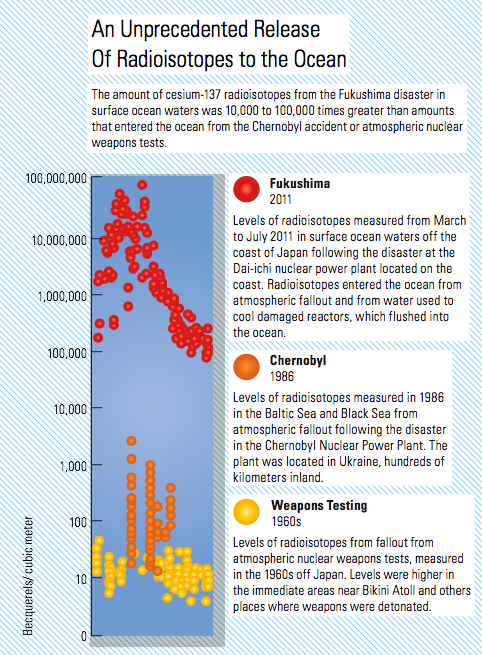
In fact, most of the cesium present in today’s oceans, Buesseler noted, is a remnant of atmospheric nuclear weapons testing conducted by the United States, France, and Great Britain during the 1950s and ’60s. Lesser amounts are attributable to the Chernobyl nuclear accident in 1986 and to local sources, such as the dumping of low-level waste from England’s Sellafield nuclear facility into the Irish Sea.

Prior to Fukushima, however, the levels of cesium-137 off the coast of Japan, as cataloged by Michio Aoyama at the Meteorological Research Institute in Japan and others, were among the world’s lowest, at around 2 becquerels per cubic meter (1 becquerel, or Bq, equals one radioactive decay event per second). Against this background, the concentrations measured in early April of 2011 were all the more alarming. At the source waters closest to the Fukushima Dai-ichi plant operated by the Tokyo Electric Power Co., concentrations of up to 60 million becquerels per cubic meter were reported, high enough to cause reproductive and health effects in marine animals.

Most of the cesium from Fukushima came from the millions of gallons of water poured onto the reactors during efforts to cool them, which subsequently flowed into the ocean as runoff or via groundwater. One major leak from flooded buildings at the plant also added cesium to the ocean. Once the leak was plugged in early April, cesium levels close to shore fell off dramatically, Buesseler said. They did not, however, fall out of sight.

“Dilution due to ocean mixing should be enough to cause a decrease in concentration down to background levels within a short period of time,” Buesseler told his audience at the Fukushima and the Ocean conference in November 2012. “Yet all the data we have show that measurements around the site remain elevated to this day at up to 1,000 becquerels per cubic meter.”

He hastened to put that number into context. “A thousand becquerels is not a big number for cesium. Just for comparison, that’s lower than the U.S. Environmental Protection Agency’s limit for drinking water. At that level, Buesseler stressed, the cesium in Japanese coastal waters is safe for marine
life and for human exposure.

“It’s not direct exposure we have to worry about, but possible incorporation into the food chain,” he said. That, and the ongoing high levels of radioactive cesium. “The fact that they have leveled off and remained higher than they were before the accident tells us there is a
small but continuous source from the reactor site.”

The routes and rates of radiation

Away from the coast in the open ocean, the radioactivity that showed up first came from fallout from the atmosphere carried out to sea by winds. The winds limited radioactive exposure on land, as more than 80 percent of the fallout fell on the sea.

Only a few weeks after the accident, a research cruise undertaken by Makio Honda and colleagues at the Japan Agency for Marine-Earth Science and Technology, or JAMS-TEC, detected low levels of both cesium-137 and cesium-134 some 1,900 kilometers (1,180 miles) from Fukushima, from radioactive gases carried out to sea by winds. The importance of the shorter-lived cesium-134 isotope, Buesseler said, was that it offered definitive proof that the contamination had originated from Fukushima. Cesium-134 is not naturally present in the ocean, and it has a half-life of only two years. Any amount of it introduced by weapons testing or other pre-Fukushima sources would have long since disappeared.

In June 2011, Buesseler led a quickly organized expedition aboard the research vessel Ka’imikai-o-Kanaloa that took a comprehensive look at the fate of Fukushima radiation both in the open ocean and in marine life. Beginning 600 kilometers offshore and coming within 30 kilometers of the crippled
nuclear plant, the research team sailed a sawtooth pattern, gathering water samples from as deep as 1,000 meters, and collecting samples of phytoplankton, zooplankton, and small fish. They also released two dozen drifters to track currents. These instruments move with ocean currents over months and report their positions via satellite.

Like their Japanese colleagues, Buesseler’s team measured elevated levels of both cesium-137 and the telltale cesium-134 in the water they collected. These levels varied widely across the sampling area, however, which indicated the complexity of the currents at play—dominated by the mostly eastward flow of the mighty Kuroshio Current, the Pacific Ocean’s equivalent of the Gulf Stream in the Atlantic.

“The first thing we noticed was that when we got to the Kuroshio, we lost the cesium-134 signal,” Buesseler said. “That confirmed that the Fukushima radioactive fallout from the atmosphere did not reach these more southern latitudes.” The scientists believe the Kuroshio acted as a barrier, blocking radioisotope-contaminated waters from flowing through it and to the south.

As expected, he said, the highest levels of radioactivity were measured closer to the shore. Surprisingly, these high levels were found not at Fukushima but much farther south, off the coast of neighboring Ibaraki Prefecture. The drifter data showed that this seeming anomaly was the result of a large circular flow, or eddy, that had trapped contamination close to shore south of the plant.

Over time, the researchers’ drifters helped to establish the routes and rate of radiation transported out into the wider ocean and revealed the complexity of currents in the region. A year after the drifters were released, WHOI oceanographer Steve Jayne showed that their circuitous tracks extended halfway across the Pacific, remaining mostly north of the Kuroshio Current. Combined with surface-water samples taken by commercial “ships of opportunity” in a program organized by Aoyama, these data show cesium mixing down into the ocean and flowing east at a rate of about 7 kilometers per day. At that rate, Buesseler said at the November 2012 conference, it would take another year for small but measurable amounts of cesium to show up off the U.S. West Coast.

(read the full article at whoi.edu)

Related: Fukushima Didn’t Just Suffer 3 Meltdowns … It Also Suffered Melt-THROUGHS and Melt-OUTS

—-
Alternative Free Press -fair use-

High schools to drug test using company of school president’s brother

RT: May 1, 2014

Three Catholic schools in the Cleveland, Ohio area will begin mandatory drug testing using students’ hair in the next school year. The CEO of the company performing the testing is the brother of one of the school’s presidents.

Gilmour Academy, St. Edward High School, and St. Ignatius High School announced the new policy to students and their parents on Monday. The schools will use Psychemedics Corporation for the drug tests on hair follicles. Psychemedics president and CEO Raymond Kubacki is the brother of St. Edward president James Kubacki.

K.C. McKenna, vice president of admissions and marketing at St. Edward High School, told the Cleveland Scene that the decision to work with Psychemedics came after several years of research led by an internal committee made up of members of the board of trustees, a faculty member, and members of the administration.

“Certainly, Jim knew a little more about the process because of his brother being involved, but his brother being CEO of that company in no way led to us making the decision to use Psychemedics,” he said.

“From Day One, I told them this was my brother’s company,” the St. Edward’s president told the Plain Dealer. But in their announcements, the schools made no mention of a connection between anyone at the schools and Psychemedics.

“The short answer is Gilmour was very much aware of that connection from the beginning and it was never an issue,” Gilmour spokesman Devin Schlickmann told the Plain Dealer.

“How we picked the company isn’t of interest to high school boys,” St. Ignatius spokeswoman Lisa Metro said. “They’re more interested in how it’s going to play out to them.” Metro also revealed why the committee decided to go with Psychemedics: “They were the only lab with full FDA clearance to do the testing we were looking for,” she added.

The schools said the drug testing is preventative, and not evidence of substance abuse among students, according to a statement on the St. Edward website. “The schools decided to initiate drug testing out of a deep concern for the health and well-being of students,” the statement says. “The primary purpose for this initiative is to give students another reason to say “no” to the pressures of using illegal drugs and to help them remain substance-free. This initiative is simply one more component in our student wellness efforts.”

However, school leaders told The Plain Dealer that the heroin epidemic in Northeast Ohio was the catalyst for implementing the program.

The statement did outline the decision to use hair testing over body fluids like urine or saliva. “Many drugs are undetectable in urine as early as 72 hours after use, whereas they can be detected in hair samples for several months after ingestion,” the statement says. “In addition, it is much more difficult to adulterate or substitute hair samples and collection is much less intrusive, as well as more cost-effective.”

Hair-testing kits cost $39 to $50 each, schools that currently work with Psychemedics told the Scene. All high school students – about 980 at St. Ed’s, 340 at Gilmour, and 1,500 at St. Ignatius – will be subject to testing at the beginning of the 2014-2015 school year, and then random testing will occur throughout the year. The three contracts combined will pay Psychemedics nearly $120,000 for the initial testing alone, the Plain Dealer reported.

According to the St. Ed’s statement, hair testing can detect drug use for up to three months. The timing of the announcement gives students a four-month warning before testing begins. “The only good thing about this is that they announced it this early,” one Ignatius student wrote on the Scene site. “They practically winked at us while saying that the test can detect drugs used up to 3 months prior to it, and the first tests won’t begin for 4 months.”

The student also noted, “We were also told that shaved heads would not work as the test can be done with even arm hair…And as a side note, the students will likely just be drinking a lot more.”

(read the full article at RT)

—-
Alternative Free Press -fair use-

v0.1