New York Times propaganda photos on Ukraine exposed

By Alex Lantier
WSWS: April 23, 2014

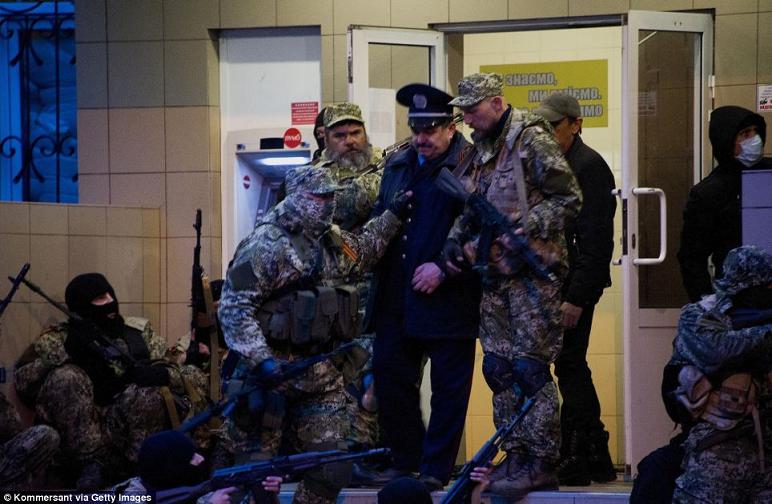
A day after the New York Times published a front-page report purporting to show the involvement of Russian Special Forces in protests in east Ukraine, its report, titled “Photos Link Masked Men in East Ukraine to Russia,” has been exposed as a blatant fabrication.

The Times printed low-resolution pictures of fighters—allegedly wearing Russian insignia while in Georgia, and then later as protesters in east Ukraine—asserting they were the same men, thus proving the existence of an armed Russian intervention in Ukraine. It was based on a crude trick first noted by a commenter on a link posted on Reddit. The photos in the Times were down-sampled versions of higher-resolution images circulating online, which show that the men in the different pictures are in fact not the same.

Images from the New York Times with text and captions:

Original images posted on reddit:

It very rapidly became clear that the Times ’ claims to have proven that Russian soldiers were driving the east Ukraine protests against the pro-Western regime in Kiev were complete rubbish.

The BBC compared the high-resolution pictures of two bearded men theTimes falsely asserted were the same fighter. It concluded, “In the 2014 photos, the man’s greying beard appears to be black, while in Georgia six years ago, the slimmer-looking man shown has a reddish beard.”

It also noted that Russian Special Forces patches on the men’s uniforms, highlighted by the Times as proof that they are Russian troops, “can be bought on the Internet for less than $5.”

Asking whether the pictures “prove anything,” the BBC concluded: “It cannot be said for sure that they are actual Russian Special Forces, as the Ukrainians argue.”

In publishing the false allegations, the Times worked closely with the US government, which received the photos from the unelected pro-US regime in Kiev and “endorsed” them before passing them on. At a press briefing, however, US State Department spokeswoman Jen Psaki, whom the New York Times quoted in its article, indicated that the administration was well aware that the photos did not constitute proof of what was being claimed.

Pressed about whether she was certain the pictures showed individuals linked to Russia, Psaki replied: “What we see in these photos that have been, again, in international media, on Twitter, and publicly available, is that there are individuals who visibly appear to be tied to Russia. We’ve said that publicly a countless number of times. I will let you draw all the conclusions yourself as to whether these are individuals who look similar or not to other events.”

A journalist at the briefing objected to calling this “evidence,” and asked, “Do you think this is evidence that would stand up in a court of law?”

Psaki replied, “I don’t think it’s a legal—we’re not making a court-of-law case here. We’re just showing that this is photographic evidence that indicates the connection we’ve been talking about for weeks now.”

The journalist asked, “You think it is proof of connection, or it’s just—or you’re just alleging that it’s another sign of this?”

Psaki replied, “It’s another sign.”

In fact, the Times has worked to mislead its readers, uncritically presenting concocted photos delivered by its contacts in the State Department.

Washington, as it passed the pictures on to the Times, knew very well that they did not constitute evidence of anything, but were simply a new propaganda point supporting its as-yet unsubstantiated accusations of Russian involvement in Ukraine. The Obama administration relied on theTimes to publish the pictures, fanning the flames of the media campaign to denounce Russia, without doing any due diligence to check that its materials were accurate or that proved anything at all.

A decade ago, Times journalist Judith Miller was the conduit for broadcasting lies that Iraq had weapons of mass destruction (WMD), touching off a huge media campaign that set the stage for the US invasion of Iraq.

Today, the lies the Times is palming off as news could provoke a war with Russia, a nuclear-armed power. By fabricating evidence of Russian involvement in east Ukraine, the Times was providing political ammunition for calls in Ukraine and in the Western imperialist powers for a military crackdown against protests in east Ukraine, a region with a large Russian population. This could lead to a military intervention by Moscow in eastern Ukraine to break up the crackdown, and a clash between Russia and Ukraine drawing in the Western powers.

The Times ’ fabrications also served to obscure the fact that this conflict arose out of the decision of Washington and its European allies to topple Ukraine’s previous, Russian-aligned regime in a fascist-led putsch in February. The unelected pro-Western regime in Kiev has now encountered significant popular opposition in pro-Russian regions of eastern Ukraine. It is this aggressive policy of the Western powers that is driving the explosive standoff in eastern Ukraine.

The employees of the Times who were involved in producing this article, like Judith Miller before them, reflect the growing integration of the media and the state.

(read the full article at WSWS or Global Research)

—-
Alternative Free Press -fair use-

Canadian Prime Minister’s Office Full Of ‘Ruthless, Cutthroat Psychopaths’

Elizabeth May: Prime Minister’s Office Full Of ‘Ruthless, Cutthroat Psychopaths’

The Huffington Post Canada: April 23, 2014

Green Party Leader Elizabeth May doesn’t mince words.

And she’s clearly no fan of the concentration of power in the Prime Minister’s Office.

The British Columbia MP made waves by using some colourful language at a Nanaimo town hall last week to describe the government staffers behind Prime Minister Stephen Harper.

According to Metro’s Luke Simcoe, May called the PMO a “$10-million-a-year partisan operation filled with ruthless, cutthroat psychopaths.”

May later explained to Metro that the comment was made in jest but did not back down from what she sees as an attitude in the PMO that puts the interest of the party in charge ahead of Canadians.

“The staff at the PMO have no allegiance to anything other than getting the Conservative Party re-elected. And they feel entitled to tear strips off bureaucrats at all levels of the system,” she said. “It completely offends the principles of parliamentary democracy.”

Of course, this is not the first time May has opened up about problems she sees with the PMO.

Last May, the MP had a memorable exchange in question period with Foreign Affairs Minister John Baird shortly after she called the PMO an “invention,” a “partisan fortress” and the least accountable place funded by taxpayers.

“About $10 million a year disappears into the PMO with zero accountability,” May said. “The guys in short pants who run around bullying MPs, muzzling scientists and harassing civil servants report to one boss. Is it not time to have accountability out of the PMO?”

Baird thought her remark smacked of sexism and rose on a point of order.
Green Party Leader Elizabeth May doesn’t mince words.

And she’s clearly no fan of the concentration of power in the Prime Minister’s Office.

The British Columbia MP made waves by using some colourful language at a Nanaimo town hall last week to describe the government staffers behind Prime Minister Stephen Harper.

According to Metro’s Luke Simcoe, May called the PMO a “$10-million-a-year partisan operation filled with ruthless, cutthroat psychopaths.”

May later explained to Metro that the comment was made in jest but did not back down from what she sees as an attitude in the PMO that puts the interest of the party in charge ahead of Canadians.

“The staff at the PMO have no allegiance to anything other than getting the Conservative Party re-elected. And they feel entitled to tear strips off bureaucrats at all levels of the system,” she said. “It completely offends the principles of parliamentary democracy.”

Of course, this is not the first time May has opened up about problems she sees with the PMO.

Last May, the MP had a memorable exchange in question period with Foreign Affairs Minister John Baird shortly after she called the PMO an “invention,” a “partisan fortress” and the least accountable place funded by taxpayers.

“Mr. Speaker, I have to rise and respond to the member for Saanich—Gulf Islands,” Baird said. “She made comments with respect to young boys in short pants. We have a lot of young, talented women also working in the Prime Minister’s Office. And I would ask her to withdraw her sexist comments.”

But May didn’t miss a beat.

“I accept that there are, then, also women employed for the purpose of harassing scientists, bullying MPs, and muzzling civil servants,” she said.

About a week after that exchange, Alberta MP Brent Rathgeber quit the Conservative caucus to sit as an Independent in part because of what he saw as the undue influence of unelected, unaccountable government staffers.

Rathgeber told reporters he didn’t appreciate staffers in Harper’s office who are half his age pressuring caucus to adhere to talking points and vote like “trained seals.”

“When you have a PMO that tightly scripts its backbenches like this one attempts to do, MPs don’t represent their constituents in Ottawa, they represent the government to their constituents,” he said.

Rathegeber also said at the time that the PMO has too much power because there isn’t enough separation between the legislature and executive.

(read the full article at Huffington Post)

—-
Alternative Free Press -fair use-

Ex-sheriff’s deputies charged with planting evidence at pot dispensary

By Kate Mather
LA Times: April 23, 2014

Two former Los Angeles County sheriff’s deputies have been charged with conspiracy, perjury and altering evidence in connection with planting guns inside a medical marijuana dispensary to justify two arrests in 2011, prosecutors said.

Julio Cesar Martinez, 39, and Anthony Manuel Paez, 32, were charged with one felony count each of conspiracy to obstruct justice and altering evidence as a peace officer, according to the Los Angeles County district attorney’s office. Martinez was also charged with two felony counts of perjury and one of filing a false report.

[…]

Prosecutors allege the former deputies wrote a report claiming that on Aug. 24, 2011, as they patrolled West 84th Place, they observed a narcotics transaction involving a person with a gun. Martinez said he followed that suspect into the dispensary, where he found two guns: one near a trash bin and another on a desk next to some ecstasy pills.

Two men were arrested: one for possession of an unregistered gun and the second for possession of a controlled substance while armed with a gun. Jane Robison, a spokeswoman for the district attorney’s office, said charges were filed against the men but later dropped.

The sheriff’s Internal Criminal Investigation Bureau began investigating the incident a year later and discovered video from inside the dispensary that was “inconsistent” with the report filed by the deputies, prosecutors said.

(read the full article at LA times)

—-
Alternative Free Press -fair use-

6.7 magnitude earthquake rocks British Columbia (April 23, 2014)

A 6.7 magnitude earthquake has struck off the coast of Vancouver Island. usgs.gov reports it was 94km south of Port Hardy, Canada and occurred at 2014-04-23 20:10:13 UTC-07:00.

So far no reports of injuries or risk of tsunami.

Canada’s 10 largest earthquakes in recorded history have been:

1 – 1700/01/26 9.0 Cascadia subduction zone, British Columbia.

2 – 1949/08/22 8.1 Offshore Queen Charlotte Islands, British Columbia.

3 – 1970/06/24 7.4 South of Queen Charlotte Islands, British Columbia.

4 – 1933/11/20 7.3 Baffin Bay, Northwest Territories.

5 – 1946/06/23 7.3 Vancouver Island, British Columbia.

6 – 1929/11/18 7.2 Grand Banks south of Newfoundland.

7 – 1929/05/26 7.0 South of Queen Charlotte Islands, British Columbia.

8 – 1663/02/05 7.0 Charlevoix, Quebec.

9 – 1985/12/23 6.9 Nahanni region, Northwest Territories.

10 – 1918/12/06 6.9 Vancouver Island, British Columbia.

Written by Alternative Free Press
Creative Commons License
6.7 magnitude earthquake rocks British Columbia (April 23, 2014) by AlternativeFreePress.com is licensed under a Creative Commons Attribution-ShareAlike 4.0 International License.

Sources:

1. http://earthquake.usgs.gov/earthquakes/map/

2. http://www.earthquakescanada.nrcan.gc.ca

US provided $500 MILLION of weapons to al-Qaeda militants, Benghazi attack was preventable, reveals damning report

-Citizens Committee on Benghazi claims the US government allowed arms to flow to al-Qaeda-linked militants who opposed Muammar Gaddafi
-Their rise to power, the group says, led to the Benghazi attack in 2012
-The group claims the strongman Gaddafi offered to abdicate his presidency, but the US refused to broker his peaceful exit
-The commission, part of the center-right Accuracy In Media group, concluded that the Benghazi attack was a failed kidnapping plot
-US Ambassador Chris Stevens was to be captured and traded for ‘blind sheikh’ Omar Abdel-Rahman, who hatched the 1993 WTC bombing plot

Benghazi attack could have been prevented if US hadn’t ‘switched sides in the War on Terror’ and allowed $500 MILLION of weapons to reach al-Qaeda militants, reveals damning report

By David Martosko
Daily Mail: April 23, 2014

The Citizens Commission on Benghazi, a self-selected group of former top military officers, CIA insiders and think-tankers, declared Tuesday in Washington that a seven-month review of the deadly 2012 terrorist attack has determined that it could have been prevented – if the U.S. hadn’t been helping to arm al-Qaeda militias throughout Libya a year earlier.

‘The United States switched sides in the war on terror with what we did in Libya, knowingly facilitating the provision of weapons to known al-Qaeda militias and figures,’ Clare Lopez, a member of the commission and a former CIA officer, told MailOnline.

She blamed the Obama administration for failing to stop half of a $1 billion United Arab Emirates arms shipment from reaching al-Qaeda-linked militants.

‘Remember, these weapons that came into Benghazi were permitted to enter by our armed forces who were blockading the approaches from air and sea,’ Lopez claimed. ‘They were permitted to come in. … [They] knew these weapons were coming in, and that was allowed..

‘The intelligence community was part of that, the Department of State was part of that, and certainly that means that the top leadership of the United States, our national security leadership, and potentially Congress – if they were briefed on this – also knew about this.’

The weapons were intended for Gaddafi but allowed by the U.S. to flow to his Islamist opposition.

‘The White House and senior Congressional members,’ the group wrote in an interim report released Tuesday, ‘deliberately and knowingly pursued a policy that provided material support to terrorist organizations in order to topple a ruler [Muammar Gaddafi] who had been working closely with the West actively to suppress al-Qaeda.’

‘Some look at it as treason,’ said Wayne Simmons, a former CIA officer who participated in the commission’s research.

Retired Rear Admiral Chuck Kubic, another commission member, told reporters Tuesday that those weapons are now ‘all in Syria.’

‘Gaddafi wasn’t a good guy, but he was being marginalized,’ Kubic recalled. ‘Gaddafi actually offered to abdicate’ shortly after the beginning of a 2011 rebellion.

‘But the U.S. ignored his calls for a truce,’ the commission wrote, ultimately backing the horse that would later help kill a U.S. ambassador.

Kubic said that the effort at truce talks fell apart when the White House declined to let the Pentagon pursue it seriously.

‘We had a leader who had won the Nobel Peace Prize,’ Kubic said, ‘but who was unwilling to give peace a chance for 72 hours.’

(Rad the full article with video at Daily Mail)

—-
Alternative Free Press -fair use-

Arizona Supreme Court Rules Cannabis Drug Test Does Not Prove Impairment

Brian Skoloff
AP: April 22, 2014

Authorities can’t prosecute Arizona motorists for driving under the influence of marijuana unless the person is impaired at the time of the stop, the state Supreme Court ruled Tuesday in the latest opinion on an issue that several states have grappled with across the nation.

The ruling overturned a state Court of Appeals decision last year that upheld the right of authorities to prosecute pot smokers for DUI even when there is no evidence of impairment.

The opinion focuses on two chemical compounds in marijuana that show up in blood and urine tests — one that causes impairment and one that doesn’t but stays in a pot user’s system for weeks.

Some prosecutors had warned that anyone in Arizona who used medical marijuana simply shouldn’t drive or they would risk facing DUI charges, a contention that drew the ire of pot advocates who claimed this interpretation of the law criminalized their legal use of the drug after voters approved it in 2010.

Tuesday’s state Supreme Court opinion removed that threat in explaining that while state statute makes it illegal for a driver to be impaired by marijuana, the presence of a non-psychoactive compound does not constitute impairment under the law.

[…]

Some states require signs of impairment before someone can be charged with driving under the influence of marijuana. Others have zero tolerance for the presence of any marijuana in the blood, whether in the form of active compounds that cause impairment or inactive compounds that don’t, while a few states have limits for how much active marijuana can be in the system, designed to be comparable to the .08-limit for drunken driving.

However, only eight of those states have laws that allow a driver to be charged with being under the influence for having even marijuana compounds in their systems that don’t cause impairment, according to the Marijuana Policy Project.

Last year, the Michigan Supreme Court ruled that medical marijuana users should have some protections and that police must show that a driver is actually “under the influence” of the drug — meaning impaired — to seek criminal charges.

Tuesday’s ruling arises from the case of an Arizona man who was stopped by police for speeding and later acknowledged having smoked marijuana the night before. Blood tests revealed marijuana compounds in his system, however, not the form that causes impairment, according to court records.

He was charged with driving under the influence of a drug and operating a vehicle with the presence of the drug’s metabolite in his system.

The state Supreme Court noted that the language of Arizona’s statute is ambiguous and does not make a distinction between the marijuana metabolite that causes impairment and the one that does not when determining whether criminal charges are warranted. Prosecutors had argued that the statute’s reference to “its metabolite” when referring to drug compounds detected in a driver’s system covers all compounds related to drugs, not just those that cause impairment.

This interpretation “leads to absurd results,” the high court panel wrote. “Most notably, this interpretation would create criminal liability regardless of how long the metabolite remains in the driver’s system or whether it has any impairing effect.”

In a dissenting opinion, Justice Ann A. Scott Timmer wrote that the law helps “enhance detection and prosecution of drugged driving” and should remain unchanged. She suggested any constitutional challenges would be better addressed on a case-by-case basis.

Maricopa County Attorney Bill Montgomery expressed disappointment with the ruling, noting the court should have left such a decision up to the Legislature to clarify.

However, attorney Michael Alarid III, who represented the man charged in the case, said “we’re very pleased, and we’re very relieved that it’s finally over.”

“This does have far-reaching impacts on medical marijuana patients,” he added. “And it basically corrects an error in the interpretation of the law.”

(read the full article at Star Tribune)

RELATED NEWS:
Study shows THC blood tests can’t test impairment


Alternative Free Press -fair use-

Alberta regulator ignores four continuing leaks, permits oilsands company to resume steam injection

Alberta regulator permits oilsands giant to resume steam injection near Primrose leaks

By Sheila Pratt
Edmonton Journal: April 22, 2014

EDMONTON – Oilsands giant CNRL won approval to resume pumping high-pressure steam into wells on its Cold Lake lease near four sites where bitumen continues to leak to the surface uncontrolled.

The Alberta Energy Regulator has not yet determined the cause of the leaks, which totalled almost 12,000 barrels in the past year. Late last week, it approved the company’s application to resume steam injection, with lower steam pressures, to keep its Primrose wells producing.

But environmentalists say allowing steam injection to start again on the Primrose lease is premature, especially since it is not known how to stop the leaks, and the same geological formation is involved in leaks in 2013 and in 2009.

In its production, Canadian Natural Resources Ltd. sends steam into the ground for weeks, builds up pressure, melts the bitumen, then brings it back up the same well — called high-pressure cyclical steaming.

This spring steaming cycle is the first injection since the leaks were discovered last May. The steaming cycle is needed to keep the wells producing.

Early last spring, the company discovered three sites where sticky bitumen had flowed into the forest, covering vegetation, and was leaking into a small lake, which has since been drained to expose the fissures on the bottom.

One theory says high-pressure steam is cracking the caprock and allowing the bitumen to flow to the surface. The company says the underground leaks start at faulty well bores.

(read the full article ay Edmonton Journal)

—-
Alternative Free Press -fair use-

Supreme Court Rules Anonymous Tip Justifies Stopping Drivers

Police may stop drivers based only on anonymous tip, rules Supreme Court

RT: April 23, 2014

Law enforcement officials may now stop US drivers based only on the information gleaned in an anonymous tip phoned in by a caller who dialed 911, the Supreme Court ruled in a tight decision Tuesday.

The high court ruled 5-4 that relying only on a comment from a 911 caller is reasonable because “a 911 call has some features that allow for identifying and tracking callers.” In most cases the justices are split along ideological lines but Tuesday’s decision was enough to split the two most conservative-minded justices, with Justice Clarence Thomas writing the majority opinion and Justice Antonin Scalia leading the dissent.

The case considered a 2008 California incident in which an anonymous 911 caller told the police that a pickup truck had forced her off the road, providing the location, as well as details such as the truck’s make, model, and license plate number. Police soon stopped a vehicle matching the description and reported smelling the odor of marijuana as they approached driver Jose Prado Navarette.

Navarette was arrested because officers found 30 pounds of marijuana in his vehicle, although he argued that the initial stop was unconstitutional because police did not have reasonable suspicion to stop his truck. His legal team asserted that the police could not have determined with any accuracy the identity of the caller or challenged her credibility.

The Supreme Court has long maintained that police may act on anonymous tips, although those tips are required to include enough detail so that officers can formulate a reasonable suspicion of criminal activity, according to NPR. Justice Thomas used this rationale in his opinion, claiming that police may have felt, based on the 911 call, that the truck driver was intoxicated behind the wheel.

[…]

Justice Scalia, who usually agrees with Thomas, wrote a stinging rebuke of the majority decision in his own dissent.

“The Court’s opinion serves up a freedom-destroying cocktail consisting of two parts patent falsity: (1) that anonymous 911 reports of traffic violations are reliable so long as they correctly identify a car and its location, and (2) that a single instance of careless or reckless driving necessarily supports a reasonable suspicion of drunkenness,” he wrote, as quoted by US News and World Report.

“All the malevolent 911 caller need do is assert a traffic violation, and the targeted car will be stopped, forcibly if necessary, by the police. If the driver turns out not to be drunk (which will almost always be the case), the caller need fear no consequences even if 911 knows his identity.”

(read the full article at RT)

Alternative Free Press -fair use-

High Radioactivity Including “Many Hot Spots” Keep Residents Away From Homes Despite Japanese Officials Claims Of Safety

Fukushima: it is my valley sievert

By Arnaud VAULERIN Envoyé spécial à Naraha et Iwaki
Liberation: March 7, 2014
(Translated using Google Translate)


Carp and maple leaves irradiated. Images straight highlight contamination concentrated in the muscles for the fish and the rod for the plant, whose leaves have grown after the disaster. (Photos Masamichi Kagaya)

A few days before the third anniversary of the nuclear disaster that was emptied of its inhabitants , Naraha has almost completed a huge site decontamination. Not sure as far as its former inhabitants are ready to return.

This is the heart of the village, the town house. But it remains an empty place and lifeless. The mayor of Naraha is a dusty crossroads of frozen drafts. A vessel aground in silence and snow. In the lobby of the hotel’s desert city nestled 15 kilometers southwest of the Fukushima Daichi , everything seems frozen since the evacuation of 7,560 residents 12 March 2011 .

A stove glows providing a hot air net two employees idle TEPCO ( the plant operator ) and two municipal officials. The former are responsible for monitoring the level of radioactivity of the few people who come to retrieve belongings . Latest assisting the State in a huge project decontamination coming to an end in this rural village and forest . Prepare all without believing the return of the population that could be allowed in the coming days.

But intentions to completion, the gap may be very large, very slow project. Long Naraha village was prohibited in the evacuation zone of 20 km around the ravaged Fukushima reactors. With animals in the wild , abandoned its radioactive winds homes and moved to Iwaki , 35 kilometers south population. Today , people can not return that day , cleaning , tidying their homes and undertake administrative tasks. ” You never see a lot of people says Shigeto Matsumoto , head of decontamination for mayor . People do not want to go . They did not want to. It’s been three years since they left. They can not believe the Department of the Environment when he argues that the radioactivity will drop to 0.3 microsieverts per hour. It’s not easy to convince them to restart the city, but you can not let go , right? ”

Although he works at City Hall, Shigeto Matsumoto is not the best return on proselyte Naraha . In the hall where his voice resounds , he ‘s slipping away “if” a hypothetical return which , according to the list , turns to mission impossible : ” If our life is recovered before ; if the people , our friends, school friends of our children back ; if we can grow without concern , it can leave. ” That’s a lot of ifs. Shigeto Matsumoto himself does not believe . The father said “Understanding the families and young people who are reluctant to return .” Before admitting that he will not return to his native village with his wife and children aged 13 and 9 years if the city approves . Many people , starting with young parents , fleeing the “invisible enemy” .

Quarantine, Toshiko Oba (1) refuses to return to Naraha with her children , ages 15, 11 and 10 years. Yet this old maid lives frugally in a narrow two -piece wooden frame on the outskirts of Iwaki , where 80 % of people found refuge (as in this neighborhood above) . A Naraha , it could find its spacious building, which has been decontaminated in December. “The mayor can say what she wants , there will always be a concern about the level of radioactivity , says this woman. Talk with neighbors and even family is painful. We will return when the children are grown . ”

The mayor of Naraha does not minimize the hidden challenges. It measured , depending on the location , rates between 1.75 and 5.25 millisieverts per year ( Paris , it is around 0.7 mSv) , without concealing the presence of many “hot spots” , these places which combine high levels of radiation. Thus, in the hamlet of Kamishigeoka in the north of the village , the farmer Tomio Shibata made ​​statements ” to 13 millisieverts in several places .” This is certainly not the maximum allowed for nuclear workers dose set at 20 mSv , but this is far from the annual exposure of 1 mSv recommended by the International Commission on Radiological Protection , a goal that Japan s’ is attached to a long term in the region of Fukushima.

Roofs , streets, rice fields , waterfront

It happens also that the authorities do Naraha curious discoveries. Last summer , during a decontamination site near the river Idegawa , workers have uncovered four ” small objects ” of sorts sips of radioactivity bars ( 8.7 sievert per year !) . Neither the Department of the Environment or Tepco , which is conducting the investigation , have the time to give an explanation on their presence in nature. Controlled by the state, as in ten other cities most heavily polluted Fukushima Prefecture , decontamination has flared up after this discovery . On rooftops, streets, gardens , rice fields and the sea , the workers and laborers cohorts dig , scrape , aspire, carve , cut, store . Police patrols pretend to monitor these titanic operations.

Naraha became the headquarters of an army of men who, for two years, have imprisoned more than 760 000 m3 of radioactive waste in big plastic balls piled on several floors in the twenty-two storage sites Naraha ( like this one , located near the shore of the Pacific ocean). The least contaminated part (that is to say no more than 100,000 becquerels per kg ) should remain in a first time on the territory of the municipality . Until the state finds a lasting solution to this radioactive puzzle.

End of 2013, Tokyo had decided that three towns in the province of Fukushima – Futaba , Okuma and Naraha – would accommodate the equivalent of 28 million m3 of waste. In other words , the government announced a definitive death for these rural communities to the declining population. But the mayor of Naraha , Yukiei Matsumoto won a tussle with the central authorities. ” He argued that the city was less contaminated than its two neighbors said Michihiro Igari , director of reconstruction department at City Hall. Afterwards, he made ​​it clear that we could never bring back the people building next to them a radioactive storage site , especially when the decontamination coming to an end . ” Naraha is not on the list common sacrificed.

Affable and busy , Michihiro Igari receives in a windowless office at the University of Iwaki , where officials Naraha found refuge. This is a city of fortune that active hive for the revival of the village. “Never give up,” proclaims a banner in the lobby. Michihiro Igari ” trying to think positively “: ” Compared to Futaba and Okuma , our situation is not entirely hopeless. ” This quiet man sketch conversion projects for Naraha . “We can aspire to be a model of reconstruction. And if you offered to residents of Futaba time to come and live in our community so that they are closer to their unlivable city as too contaminated? We could also host a research center to support the decommissioning of the plant that will last for decades. ”

These projects have not made ​​Michihiro Igari a smug optimism , a follower of autosuggestion . While stressing that 90% of the city is cleared , he immediately adds that this applies only farmland and residential areas, with a perimeter of 20 meters. In other words, at least 70 % of the territory of the municipality consists of hills and forests has not been decontaminated . ” This is not part of the plan of the government, noted Michihiro Igari . No timetable or action plan are anticipated. But there is much more serious : the water that we consume from rivers , dams has obviously not been decontaminated . ”

Faults and damage in series

Last week , a survey of Fukushima Prefecture has also revealed that hundreds of water supplies for agriculture had very high levels of radioactivity . Even if he speaks with a soft voice , this has the gift to annoy the farmer Tomio Shibata, whose land and rice fields adjacent forests in the hamlet of Kamishigeoka . “This is a very big problem . If it rains, if there is wind , it will grab everything in our soils that have been decontaminated yet . We absolutely can not say that the work is done. ” His friend Mitsao Sato agrees. Shoulders and hands remover butcher , the jovial farmer lost everything 12 March 2011 . That day , he opened the doors of its stable and squandered its eight cows and seven calves, before giving his land ” the invisible enemy . ” Three years later , he thinks only of returning. At 69 , he does not want to worry about his health. But his laughter mask just pessimism . As an expert in radiation of the Town Hall , Shigeto Matsumoto , former housekeeper Toshiko Oba and his friend Tomio Shibata, he laments the situation at the Fukushima Daichi subscribes to failures and damages in series. “Every water leak announced on television , people are concerned and it makes them back. This plant is not stable. ”

Reactor , health and food, Fukushima region has permanently lost the battle images for three years. “People in Tokyo do not already buy food produced near the plant. So do you think we installed next to reactors, we can make them eat our rice and our meat , yet checked regularly. Well no , of course! ” Whatever, Mitsao Sato (see cons ) return. He was born there. His friends are rice farmers, gardeners, farmers , foresters. He has always lived on agriculture as three-quarters of families Naraha – the remaining quarter worked at the plant and in a handful of SMEs. He knows he will get out. ” But there will be no respite , he predicts . Young people do not want to go , including my family, and I understand . I do not dare ask them to do. Finally, the biggest concern , it is perhaps not the contamination , but the return of the inhabitants ” He believes that in the best case , only half of the population, all ages , come back. ; Naraha not work like a real city. In this rural area and aging , nuclear crisis precipitated depopulation raging for some twenty years. Time did the rest .
“Even if the vermin seized tatami ”

This morning, Ichiro Sato (1) are found in the center of Iwaki support. It transpires in his blue sweatshirt and gray sweatpants . He just attended a course in dietetics and a lesson in the gym. Slender and alert to 74 years , he announced his return to Naraha soon as the mayor has given the green light . He says he will return to his home ” even if the water is not drinkable , even if vermin seized tatami mats , futons and clothes , although decontamination did not reduce the radioactivity in my house , even if nature will never be like before . ” As the conversation progresses, the smile fades . He had a well in his garden , it is contaminated. When he returned to his home in Iwaki , it makes it “sad” . In December, the council had authorized the inhabitants of Naraha to spend the festive season in their village to help return. Ichiro Sato did not make the trip . ” Psychologically and practically, I was not ready . I do not see myself in my sleep . ”

Flanchent good resolutions . The former farm worker cites the case of his friends , as the months passed , are very well made ​​life Iwaki , the big city with its physicians, its buses , department stores , its activities and recreation. “They finally find it very convenient to live here. ” Ichiro Sato did not confess , but when he speaks of his friends , everything indicates that it is first to him he thinks.

(1) The name was changed.

(This article was originally published in French at Liberation)
Article was translated using Google Translate.

More radiation images can be viewed at autoradiograph.org‘s Facebook Page 放射線像 (Radiation image).

—-
Alternative Free Press -fair use-

US Supreme Court Rejects Florida Drug Testing Appeal

Phillip Smith
Stop The Drug War: April 21, 2014

The US Supreme Court Monday declined to review a lower court ruling that found Florida Gov. Rick Scott’s (R) plan to randomly drug test state employees unconstitutional.

The decision by the nation’s highest court means that the ruling by the 11th US Circuit Court of Appeals finding the plan unconstitutional stands.

The drug test-happy governor had issued an executive order in March 2011 directing all state agencies to drug test new hires and randomly test current employees. But that order was challenged by the American Federation of State, County, and Municipal Employees Council 79, representing state workers.

The union argued that random drug testing was a violation of the Fourth Amendment’s proscription against unreasonable searches and seizures. In its decision, the 11th Circuit generally agreed with the union, finding the suspicion-less drug tests unconstitutional, but also ordered the state and the union to determine which state employees could be subjected to such testing.

(Read the full article at Stop The Drug War)

—-
Alternative Free Press -fair use-
v0.1